Navigating Interest Rate & Inflation Trends

If you’ve been in Singapore the past few years, you’ve probably noticed two things: your grocery bill has gone up, and your mortgage repayments back at home might have too. Interest rates and inflation don’t just impact big economies – they hit everyday expats in very real ways.

The challenge? These two forces often work together to squeeze your finances from both ends. Inflation erodes your purchasing power, while higher interest rates increase the cost of borrowing. But with the right strategies, you can protect yourself, and even find opportunities.

1. How Interest Rates & Inflation Work Together


Inflation: Prices rise, your money buys less.
Interest Rates: Central banks adjust rates to try to control inflation, which impacts loan costs and investment returns.
For Expats: You might be earning in SGD, paying loans in another currency, or vice versa…meaning you face multiple layers of impact.



2. Impact on Mortgages & Loans


Floating Rate Loans: Your repayments can rise quickly as interest rates climb.
Fixed Rate Loans: Offer short-term protection but may revert to higher rates later.
Multi-Currency Loans: Add currency risk to the mix; a weakening home currency can make repayments more expensive.

If you’re planning to be in Singapore for several years, explore refinancing or partial prepayment to lock in manageable terms.



3. Investment Strategies in High Inflation


Equities with Pricing Power: Companies that can pass increased costs to customers.
Inflation-Linked Bonds: Adjust payouts based on inflation rates.
Real Assets: Property, REITs, and infrastructure funds often provide inflation protection.
Shorter Duration Bonds: Less sensitive to rising rates than long-duration bonds.


4. Cash & Emergency Funds


• Keep enough liquidity for safety (3–6 months of expenses), but avoid holding excessive cash, as inflation will erode its value.
• Consider short-term fixed deposits or money market funds for better returns without high risk.


5. Currency Management

If you’ll eventually move your money to another currency (for retirement or repatriation), inflation and interest rate differences between countries matter.
• Diversify across currencies.
• Use hedged share classes for global funds where appropriate.


6. SRS & Long-Term Planning

When rates rise, bond-heavy SRS portfolios may underperform. Consider:
• Increasing equity exposure if suitable for your risk tolerance.
• Adding assets less sensitive to rate hikes.


Interest rates and inflation don’t need to derail your financial plans. By actively managing your loans, investments, and currency exposure, you can turn economic headwinds into manageable breezes, and even use them to your advantage.
Macro Outlook & US Market Opportunities

We are all waiting on baited breath for the results of the US Election. What will the result mean for us as investors? Let’s take a look at a Macro Outlook overview & some key points to take note.

Macro Outlook

Attractive Valuations

• Asian Emerging markets are currently offering more attractive valuations compared to U.S. and other developed markets.

• These attractive valuations present a cost-effective entry point for investors seeking growth opportunities.

Declining Inflation and Interest Rates

• Recent trends indicate a decline in inflation rates across many emerging markets. This trend is expected to lead to lower interest rates over the next 18 months to two years.

• Lower interest rates can stimulate economic growth by making borrowing cheaper, which can boost consumer spending and corporate investment.

Weakening U.S. Dollar

• A weaker dollar can improve trading conditions for emerging market economies by making their exports more competitive on the global stage.

• A weaker dollar can attract foreign investment capital, as returns from these investments may be amplified when converted back into stronger currencies.

Bond Market Opportunities

• Yields continue to be elevated as compared to pre-2022, at the top of its percentile throughout history.

• With interest rates stabilising, fixed income, which exhibits 1/3 the volatility of equities, can act as a defensive portfolio diversifier, and an investor can lock in current yields at above average levels.

• With higher starting yields, expected forward returns are consequently higher and the correlation and statistical significance is high. 

• In this Fed pause cycle, yields have fallen lesser than average, and a mean reversion would see a larger potential for capital appreciation.

What If Trump Wins?

I was going to include ‘What If Harris Wins?’…but it seems like that probably won’t be the case! So what happens if Trump does win?

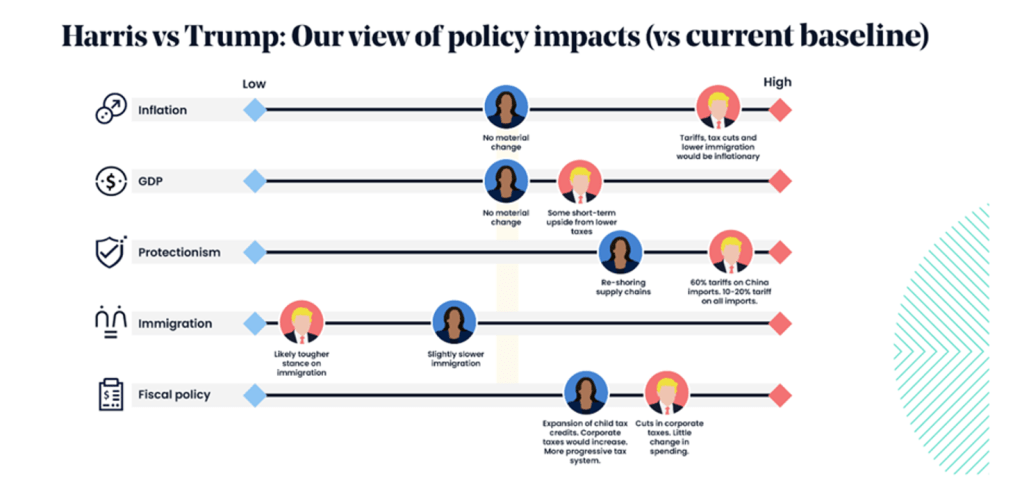
•Trump’s policy around trade tariffs, tax & immigration would be inflationary.

•There would be less interest rate normalisation, as the Federal Reserve may not be able to cut interest rates as rapidly.

•Reflecting on Trump’s previous presidency, high yield bonds & stocks outperformed due to favourable policies, which were pro-business and pro-markets.

• During his last election, in November 2016, small caps in those initial months performed well, double the performance of the S&P 500.

Graph above shows Small Cap ETFs in 2016

Investment Opportunities

· Many emerging market assets have been undervalued in the past, providing a compelling entry point for investors. By reallocating funds into EM/Asia funds, we can capitalise on these undervalued opportunities, positioning ourselves for substantial growth as these markets normalise.

· In addition, high yield bonds are less sensitive to inflation and have a current distribution yield of 7.8%. 

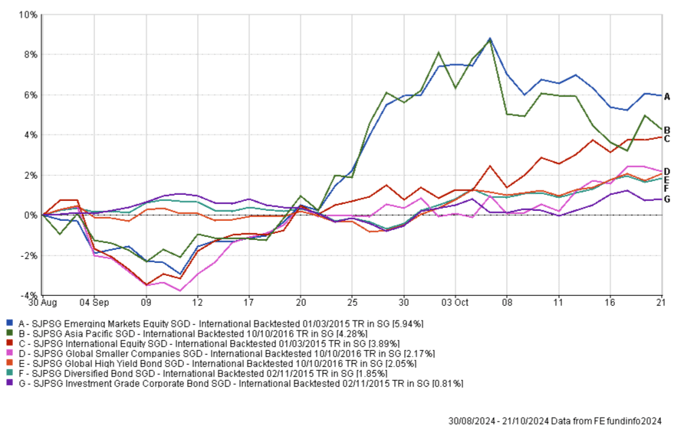
A Tale of Two Halves: After the Fed rate cut, we see an uptick & opportunity in Asia & EM. We also see a stable & resilient Global High Yield Bond.