
Macro Outlook & US Market Opportunities

We are all waiting on baited breath for the results of the US Election. What will the result mean for us as investors? Let’s take a look at a Macro Outlook overview & some key points to take note.
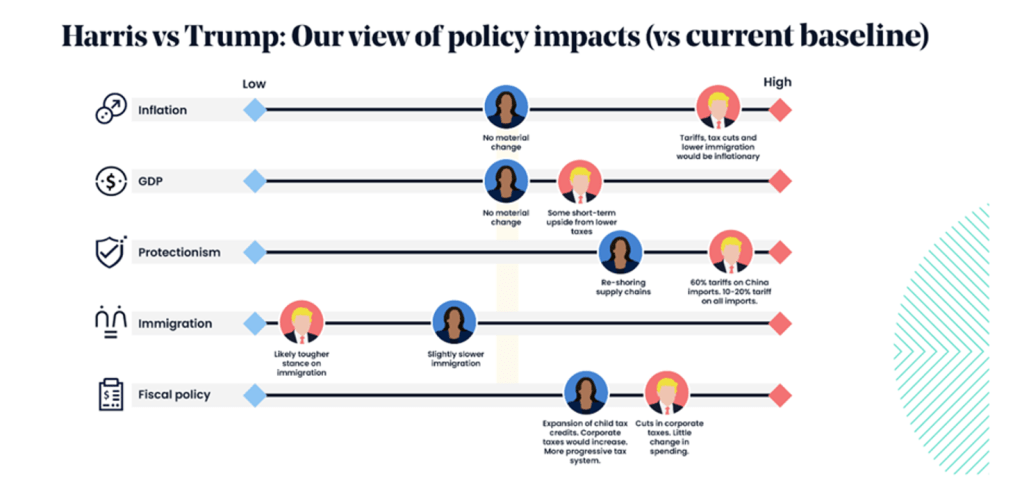
Macro Outlook

Attractive Valuations

• Asian Emerging markets are currently offering more attractive valuations compared to U.S. and other developed markets.

• These attractive valuations present a cost-effective entry point for investors seeking growth opportunities.

Declining Inflation and Interest Rates

• Recent trends indicate a decline in inflation rates across many emerging markets. This trend is expected to lead to lower interest rates over the next 18 months to two years.

• Lower interest rates can stimulate economic growth by making borrowing cheaper, which can boost consumer spending and corporate investment.

Weakening U.S. Dollar

• A weaker dollar can improve trading conditions for emerging market economies by making their exports more competitive on the global stage.

• A weaker dollar can attract foreign investment capital, as returns from these investments may be amplified when converted back into stronger currencies.

Bond Market Opportunities

• Yields continue to be elevated as compared to pre-2022, at the top of its percentile throughout history.

• With interest rates stabilising, fixed income, which exhibits 1/3 the volatility of equities, can act as a defensive portfolio diversifier, and an investor can lock in current yields at above average levels.

• With higher starting yields, expected forward returns are consequently higher and the correlation and statistical significance is high. 

• In this Fed pause cycle, yields have fallen lesser than average, and a mean reversion would see a larger potential for capital appreciation.

What If Trump Wins?

I was going to include ‘What If Harris Wins?’…but it seems like that probably won’t be the case! So what happens if Trump does win?

•Trump’s policy around trade tariffs, tax & immigration would be inflationary.

•There would be less interest rate normalisation, as the Federal Reserve may not be able to cut interest rates as rapidly.

•Reflecting on Trump’s previous presidency, high yield bonds & stocks outperformed due to favourable policies, which were pro-business and pro-markets.

• During his last election, in November 2016, small caps in those initial months performed well, double the performance of the S&P 500.

Graph above shows Small Cap ETFs in 2016

Investment Opportunities

· Many emerging market assets have been undervalued in the past, providing a compelling entry point for investors. By reallocating funds into EM/Asia funds, we can capitalise on these undervalued opportunities, positioning ourselves for substantial growth as these markets normalise.

· In addition, high yield bonds are less sensitive to inflation and have a current distribution yield of 7.8%. 
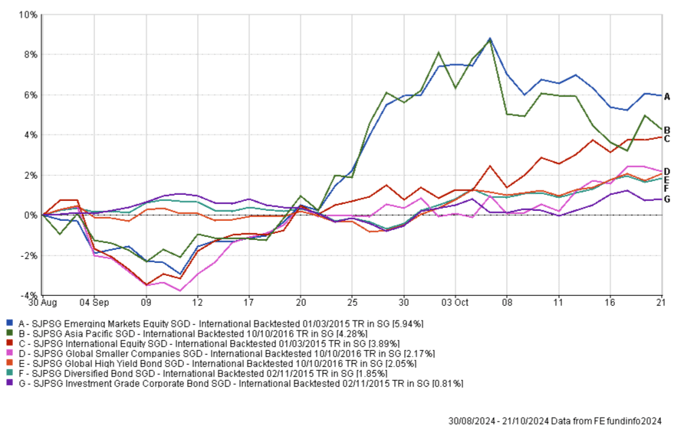
A Tale of Two Halves: After the Fed rate cut, we see an uptick & opportunity in Asia & EM. We also see a stable & resilient Global High Yield Bond.

Navigating the Changes: Key Highlights from the UK Autumn Budget 2024

With the recent unveiling of the UK Autumn Budget 2024, significant changes to personal and corporate tax regulations are set to reshape financial landscapes for individuals and businesses alike.

In his latest write-up, Peter Webb, our expert technical consultant delves into the nuanced details of these tax adjustments, providing clarity on what to expect moving forward. From adjustments to income tax thresholds to corporate tax rate modifications, understanding these changes is crucial to effective financial planning.

Join us as we explore the implications of this budget on your financial strategy and what it means for the future of taxation in the UK.

Personal

  • Rates of income tax and National Insurance (NI) paid by employees, and of VAT,
    to remain unchanged
  • Income tax band thresholds remain frozen until 2028
  • Basic rate capital gains tax on profits from selling shares to increase from from
    10% to 18%, with the higher rate rising from 20% to 24%
  • Rates on profits from selling additional property unchanged
  • Business Asset Disposal Relief tax rate to rise to 18% over the next 2 tax years
  • Business Relief and Agricultural Property Relief will be limited to £1mn from April
    2026 with 50% IHT relief above that limit
  • IHT relief on AIM shares to be limited to 50% (ie e􀆯ective 20% IHT rate)
  • Stamp duty surcharge, paid on second home purchases in England and Northern
    Ireland, to go up from 3% to 5%
  • Point at which house buyers start paying stamp duty on a main home to drop
    from £250,000 to £125,000 in April, reversing a previous tax cut
  • Threshold at which first-time buyers pay the tax will also drop back, from
    £425,000 to £300,000
  • 5p cut in fuel duty on petrol and diesel brought in by the Conservatives, due to
    end in April 2025, kept for another year
  • Basic and new state pension payments to go up by 4.1% next year due to the
    “triple lock”, more than working age benefits
  • Inheritance tax threshold freeze extended by further two years to 2030, with
    unspent pension pots also subject to IHT from 2027


Business

  • Companies to pay NI at 15% on salaries above £5,000 from April, up from 13.8%
    on salaries above £9,100, raising an additional £25bn a year
  • Employment allowance – which allows smaller companies to reduce their NIC
    liability – to increase from £5,000 to £10,500
  • Tax paid by private equity managers on Carried Interest to rise from up to 28% to
    up to 32% from April
  • Main rate of corporation tax, paid by businesses on taxable profits over
    £250,000, to stay at 25% until next election”

We encourage our readers to engage with us on this topic. If you have questions about how these budget changes may affect your personal or corporate tax planning, or if you need expert advice tailored to your specific circumstances, please don’t hesitate to reach out. You can connect with Peter & I through the comments section below or contact us directly at peter.webb@sjpp.asia. Your financial well-being is our priority, and we’re here to help you navigate these changes effectively!