The Top Ten Most Expensive Cities In 2022

Every year, Mercer rank the world’s most expensive cities to live in; the criterium is based off of things like rent, transportation costs and food. This year we’ve had a lot of volatility in the economy, exacerbated by the war, inflation rate and interest rate hikes. So, how did this affect the listings this year? Let’s take a closer look:

10. Beijing

Beijing is still a lot more affordable than the other cities on this list, but the main reason it has become increasingly more expensive is due to its population size. The city’s increasing population has caused rental prices to double over the past ten years.

9. Tokyo

Tokyo is in this list year after year. Japan in general is a country with high cost of living expenses, such as rent, owning a car and transport in general.

8. Singapore

Here we are, Singapore. No one is shocked to this here- over the past year rental prices have shot up astronomically and the lack of land will always mean that property purchase is expensive in comparison to other countries. Speaking from personal experience, going out for food and drinks can be particularly expensive, taxis, whilst cheaper than the UK, have increased over the past year and we all know owning a car is pricey in Singapore.

7. New York City

NY has always been more expensive than other places in the US, particularly rent. If you haven’t read my article, ‘Sex and The City, and Broke’, please do! I have always been baffled by how people on low to mid salaries can live comfortably in this city

8. Tel Aviv

A common theme on this list is rental; this seems to be the main reason cities land here, and the same goes for Tel Aviv. Whilst the city has a tonne of stuff to do for tourists, including bars and restaurants, this comes with a price tag. This means that rent for a one-bed, on average, is about 1725 USD a month!

5. Bern

We’re getting to the part of the list now where most of the cities are in Switzerland. A week-long holiday to the capital city would cost a family of four approximately $6000!

4. Basel

This city has a great art and history scene; Switzerland’s oldest university city is home to beautiful modern architecture and the world’s biggest art fair. This comes with a whopping price tag of living expenses of approximately $3000 a month.

3. Geneva

Similar to the previous Swiss city on this list, living in the luxury city of Geneva would cost you approximately $3500 a month. Very pricey!

2. Zurich

The financial capital of Switzerland sits at the second spot. It’s the most expensive Swiss city to rent, and the city itself is choc a block full of high shopping and decadent restaurants, so it’s very difficult to escape the high cost of living in Zurich.

1. Hong Kong

Are we shocked? HK has over 7 million people living in the city, meaning that the demand for housing is incredibly high. Not only that, food, transport and nightlife is also very expensive in Hong Kong. One thing I will always remember is watching a documentary showing people in HK living in literal cages, with a bed, TV and all their stuff. These types of housing have a shared bathroom and small kitchenette and can cost about 500 USD a month! That’s so expensive for such a small, cramped space.

In my opinion, I’m not shocked that the vast majority of these cities are European (40% of this list are in Switzerland!) and I’m actually surprised that London wasn’t now in the top 10 (it’s 15th). I did think that where we live, Singapore, would be higher because of the high cost of alcohol & rental, but I guess our lower taxes and the fact that the government are able to stop inflation and utility bills from getting out of control helps. All in all, this list is very useful when it comes to someone making a decision to move overseas.

Did this list shock you? Is your city an expensive place to live?

FIRE Movement; What’s it all about?

The term ‘FIRE’ seems to be all over the news lately, what is the hype and what does it mean?

FIRE stands for ‘Financial Independence, Retire Early’, and this is a movement that we’re seeing as of late, whereby people are leaving the workforce as early as they possibly can. They do this by focusing on scrimping and savings as much as they can now, in order to save the maximum amount for their retirement. This means cutting down on all unnecessary expenses; eating out less or almost never, not taking any holidays, even working a part-time job on top of full-time employment to earn extra income, and using all of the surplus cash to stringently invest and save. This can be quite extreme; leaving the workforce early is maybe one of the biggest financial decisions of your life, so you need to make sure you have planned correctly.

There are actually a few kinds of FIRE, which I will delve into in this article.

Fat FIRE

If you like the idea of retiring early, but don’t want to drastically alter your lifestyle to the point where you never go out or do anything fun, then Fat FIRE might be a method that interests you. Fat FIRE appeals to those who cannot keep their expenses low; if you have a family you need to pay for education, schooling, groceries, school uniforms etc., which are often difficult or impossible to trim (you can’t ask your kid’s school to lower their fees, for example). So how do you achieve FIRE with higher expenses? The answer, a higher income. Fat FIRE only works for higher income earners that choose not to fully embrace frugality. You can see this may not be for everyone- getting a higher income is easier said than done as may require certain experience, knowledge, education and so on, that might not be applicable to all.

Barista FIRE

This FIRE movement does just what it sounds like; working part time (in a café or otherwise) to supplement your retirement income. This might work for a lot of people; even I myself don’t want to do nothing during my retirement. Getting paid to do a passion-project as a free-lancer sounds like an awesome way to spend my time. This method of FIRE means that you don’t have to completely cut out all lifestyle expenses during your working years, as you know that there will be a part-time income rolling in throughout retirement. This is contrary to the next FIRE method…

Lean FIRE

Lean FIRE Method is really the extreme, hardcore or by-the-book method. Lean FIRE means you really live that minimal lifestyle right into retirement. This includes tactics like bringing your own water bottle and packed lunch with you when you’re out, taking public transport or walking from point A to point B and downgrading your rent by renting out a single room instead of a whole unit. Even someone on a lower income can practice Lean Fire, and put their monthly surplus into savings and investments. This method of FIRE really reminds me of the show ‘Extreme Cheapskates’.

Coast FIRE

In my opinion, Coast FIRE is the most realistic and less extreme method; it’s actually quite similar to the advice I give my clients; invest early and as much as you can, and enjoy the compound interest later in life. The earlier you start investing, the better; you have a longer runway and more time for that interest to accumulate. Holding your investments longer also means that you are able to tolerate volatility in the stock market.

FIRE can be studied in depth and is an interesting movement. Later on, I will explore further as to whether this method is sustainable. But, what do you think? Will you be practising FIRE any time soon?

The 52 Week Saving Challenge

If you’re struggling to figure out a way to save money effectively, or you find yourself always waiting for your payday to come in, here’s a great challenge you can set yourself and see how much you can save!

This challenge is very simple; during the first week, try to save $1, $2 during the second week and so on and so forth, all the way up to week 52 where, you guessed it, try to save $52!

You can create a savings chart or tracker so that you can ensure that you’re saving every week, and I would recommend putting these savings into a different bank account, so that you’re not tempted to spend it!

This challenge instils great saving habits, starting off small and working up towards a big goal, and by the end of the challenge you’ll have saved a whopping $1378! You can put this money towards a big-ticket item, or save it for when you graduate or any other life stage. And if that was too easy, try the 52 Week Saving Challenge, followed by doing it in reverse, doubling your money!

Give it a try and happy saving!

How Will Inflation Affect Your Long-Term Planning?

We’re all been hearing about how bad inflation is and that it’s increasing etc. But what does this actually mean and how does it have a lasting affect on our money planning?

What Is Inflation?

Simply put, inflation is when the cost of goods and living increases. Whilst some see this as a bad thing, slight inflation is good as it is a sign of a growing economy; meaning more employment, higher profits and an increase in production. But, right now, we are seeing a significant rise in inflation. In December of 2021, Singapore saw inflation hit a 9 year high of 4%.

How It Affects Us Now

This increase directly affects us, and you may have even felt a bit of a pinch. Food is a bit more expenses and energy prices seem to have gone through the roof. All of this means that your cold hard-earned cash has less spending power, essentially meaning that you cannot buy as many things with the same amount of money as you used to. What further exacerbates this problem is bank interest rates; most current accounts in Singapore have an annual interest rate of 0.05%, meaning the bank gives you that much extra each year (not a lot at all). If current inflation rate is at 4%, you are losing 3.95% of your money every year by just leaving it in your bank account! This means that whilst you are earning money, not only are things getting more expensive but you’re losing money in your bank account too!

How It Affects Our Future

As you can imagine, this situation has a massive knock-on effect for our futures. If inflation increases, or even plateaus at say about 2%, you are still losing money in your bank account. Food, housing, medicine and energy will continue to go up in price, meaning each year you will either be able to afford less, or have to spend more to keep up. Not only that, your savings will not be as powerful as it once was…so you can see how this is a problem two-fold!

How Can We Stop This?

But fear not! If we prepare now ahead of time, we can manage inflation so that it doesn’t eat away at our savings. There are a few things you can do in preparation: first, include inflation in any planning you do. Want to save up for a holiday in 5 years’ time? Inflate your ticket and hotel prices by at least 2% per annum (3% if you want to be safe). Secondly, consider using vehicles and instruments that will offer you higher returns than your current bank account- any % higher than current inflation rate will give you a positive yield, and will ensure that your savings don’t run dry. I also think it’s best to create multiple avenues for growing your money, so that if one option is not doing well, at least you have money in different areas that you can withdraw from. Lastly, do not underestimate how much different sectors will increase. Food, healthcare, housing etc. do not always follow the same trend or inflation rate. Ensure you have medical expenses covered and calculated into your long-term planning, as well as remembering that your income will not go as far in future unless you ensure there are increases.

Essentially, it is best to start planning now instead of panicking later on in life, realising that you could have prepared for inflation but didn’t. As always, it’s best to stay in-the-know, and consult a professional when it comes to your financial planning.

Hospital & Cancer Insurance; Updates YOU Need To Know About

  There have been some new updates to Integrated Shield Plans (hospital insurance) in Singapore you need to know about. The MediShield Life Council reported that spending on cancer drugs has been increasing by 20% a year; a stark contrast to the 6% spending increase for other drugs. To curb these rising costs, MOH has come up with a Cancer Drug List.

The Cancer Drug List contains drugs that are effective and cost-efficient drugs and treatments that insurance companies will cover. If the drug is effective but not cost-effective, insurance will not cover it. Not only this, even if the drug is very cheap, but does not improve the cancer treatment, insurers won’t cover.

Those with Integrated Shield Plans, will not allowed to be covered for treatment not on the list, even if they are still on treatment. Although this sounds very daunting, MOH has stated that close to 90% of current cancer drugs and treatment in Singapore are on this list.

While this isn’t ideal, and of course may affect many people, it does mean that your insurance premiums won’t skyrocket up and up each year. Medical inflation is already very high in Singapore; this is one way the government are stepping in to stop it from going out of hand.

But what does this mean for insurance moving forward? I would strongly suggest adding a cancer coverage to your portfolio, to cover the shortfall of possibly having to pay for a drug not on the Cancer Drug List. Receiving a lump-sum payment can help pay for monthly cancer drug expenses, which can be approximately $2,300 a month.

How do you think this affects you in Singapore?

Why Did Crypto Crash?

  It seems that we can’t catch a break this year, markets are down, there’s a war, inflation is up, and now the value of cryptocurrency has plummeted, leaving many feeling disheartened with their investments. But, why did it happen? It’s actually a much broader picture. Let’s do a deep dive…

Inflation

  The first thing that triggered the crash was investors losing confidence in cryptocurrency and fearing the rise in inflation; inflation has been rising the past few months and apparently has not reached it’s peak yet! This is somewhat due to customer demand after the pandemic, along with Russia invading the Ukraine.

Interest Rates

  The Federal Reserve raised its benchmark interest rate by 0.75%, which has been the biggest increase since 1994. This has had a massive impact on the crypto market. Interest rates make debt more expensive and negatively affect the economic climate; it can decrease the value of asset classes, particularly stocks and of course…cryptocurrency.

Stock Market

  As I previously mentioned, the hike in interest rates and inflation has massively affected the stock market; recently the S&P 500 decline has been even worse than at the height of the pandemic, as it dropped 5.8%. All these factors indicate a global recession is coming, and usually during bear periods, higher risk assets, including crypto, take a hit.

High Yields Were Promo Rates

  Many crypto platforms, such as Celcuis, offered returns of 18% and some platforms even more. These rates of returns are even higher than that of the stock market and could not be sustained year upon year for a long period of time- some were merely promo offers to get their platform some buzz and traction. Many people thought that this was a risk-free yield…definitely not the case! That 18% had to come from somewhere, essentially a borrower, and when more people want to gain these returns instead of borrow…that’s when problems arise.

Energy Crisis

  I’ve already mentioned the Russian-Ukraine crisis but the knock-on effects of the energy crisis have taken its toll on crypto too. If you’ve read my previous articles on cryptocurrency and the environment, you’ll know that mining crypto coins uses up a hell of a lot of energy. The cost of electricity has massively gone up since the Russian sanctions were put in place, meaning that it costs a lot to mine coins. This lowers the profit margins of the cryptocurrencies, depreciating their value.

In Summary

  To summarise, it was not just cryptocurrency that took a hit during this period; global markets are down, and many people are feeling the pinch. Rising living costs often leaves less disposable income for other things, including investment. But remember, historically bear markets (when the market is down) last on average for about 12 months, whereas a bull market on average lasts for 2.7 years…so the good times are mostly longer than the bad.

  One thing to remember is that cryptocurrency is unregulated and financial authorities cannot step in if anything goes wrong. This makes it a higher risk investment; remember that before you invest.

Is Corporate Insurance Enough?

One of the benefits of being an expat in Singapore is that a lot of the time, your company will provide you with insurance. This, know as Corporate Insurance or a Group Policy is a great relief for many expats- the company will reimburse for any hospital costs, and they don’t have to worry about navigating the somewhat complex insurance/medical landscape of Singapore.

  But is this insurance sufficient for you? Let’s delve further…

Coverage

Whilst company coverage has its strong points, like GP & Specialist reimbursement, sometimes it really lacks in certain areas. Generally, most basic group insurance packages come with quite low hospital coverage. You will also want to check if this covers private as well as government hospitals. Turnaround time at private hospitals tend to be very fast in comparison to government, so it would be good to have that option.

  Personal hospital policies tend to have very high coverage in comparison. Moreover, you can tailor coverage such as death, critical illness and disability, based on your exact needs and budget.

Service

With most group insurance, in order to claim you must either contact your HR or upload your claim to an app and wait for an approval. A lot of the time the insurance agent will not be at your beck and call, as they service every claim in the company, not just yours. And if your company has gone through a broker, it can be even more difficult to make direct contact with your insurance company. Sometimes, if your company has gone for an international insurer, you may be stuck calling an overseas hotline.

  In contrast, if you choose your personal advisor wisely, they will be more than happy to help you with all of these admin chores, from filing claims, to booking appointments, to contacting the insurance company directly on your behalf.

Longevity

This is very dependent on how long you think you will stay in the current company you work for. If you think you’ll stay with one company your whole time in Singapore, then great, you can rely on their coverage. But, what if you want to switch, and the new company doesn’t offer insurance benefits? Or maybe they do, but it isn’t as comprehensive, or they don’t include dependents? You may be in a bit of a tough spot, particularly if you have had pre-existing conditions, or if you’ve claimed in the past. This may rule you out from getting a personal plan.

Bumps In The Road

Building on my last point, there may be a lot of issues you could face, that you wouldn’t from a personal policy. Your company may decide to change provider, in order to minimise costs, which may lead to discrepancies in your coverage, especially if you are already going through a claim or have a surgery planned. With a personal plan, so long as you keep up with your payments, you cannot get excluded from any coverage after purchasing. It’s always best to plan your insurance whilst you’re healthy and able to purchase; so relying on your corporate insurance may mean that you delay this crucial planning.

I always say to my clients that Corporate Insurance is a great base of coverage; it’s a good safety net and it’s a wonderful benefit for your company to provide. However, I always encourage expats to get personal coverage, to ensure that their protection is in their own hands, and not the hands of a company that may switch or drop coverage in the long run.

Tax Relief For Foreigners

It’s tax filing season, and a lot of expats here in Singapore don’t know that they’re eligible to certain tax reliefs. Today I’ll be talking about how you can legally save on your taxes in Singapore. Just a disclaimer, My job isn’t tax planning, I’m a financial consultant, but these are some things that I do and have researched, that you can put into practice. And of course, this is just for Singapore. I know about some tax laws in other countries but I’ll just be talking about Singapore today.

I want to do a quick overview of the tax system in Singapore, tax reliefs available here and a bit of an example of SRS savings. So you may be shocked as to how many expats are in Singapore. It’s actually approximately 1.68 Million. So quite a lot, but 1 in 8 lost their job in 2020. While job security is a worry to most of us, at least Singapore is doing quite well when it comes to dealing with Covid. And unemployment rate is definitely not as high as other countries during this crisis. There are also many affluent citizens and residents here. Tax, whilst low in Singapore, can still take away a large chunk of your salary.

For tax in Singapore, the amount you pay is broken down into various brackets. Singapore is seen as one of the top first world countries for having low tax, it’s somewhat of a tax haven, but you can see that if you are in the higher income bracket, for example $200k and above, your tax for the year is quite substantial.

So, how can we legally minimise the amount of tax we are paying each year?

There are several things that can give you tax relief. This may appeal more to those that plan on staying here long term, or even longer than just a couple of years, as all these reliefs add up in the long run.

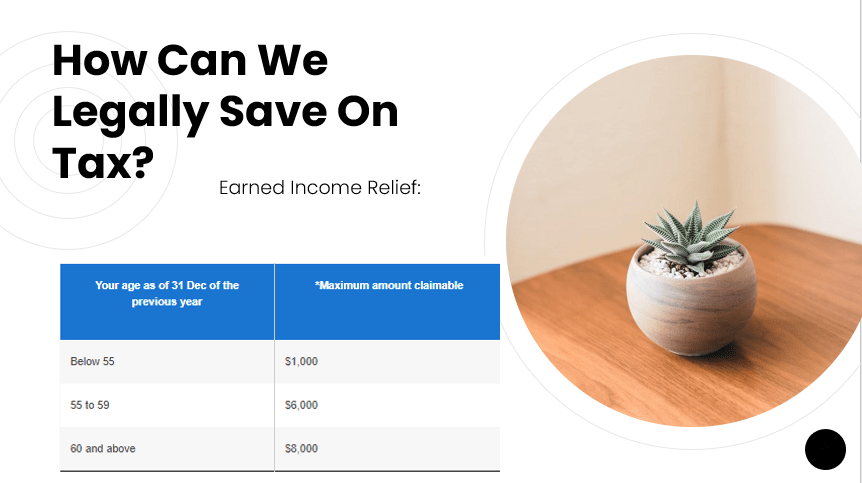
The first and easiest tax relief you can get is employment relief. This is automatically calculated into your tax and is capped at $1,000 for below 55. And then it goes up depending on age bracket.

Next is life insurance relief. If you have any insurance policies from an insurance company in Singapore, you are entitled to a relief of maximum $5,000 per tax year, provided the insurance is for yourself, and is not an accident or hospital policy, or a pure investment policy. This relief can be filed at the end of the tax year under e-filing.

If you have anyone here with you on a dependent pass and they’re not working, you can claim for tax relief. You are entitled to claim $2,000 for spouse, $4,000 for child and $9,000 for a parent on a DP.

To me, this is the most effective way to save on taxes. SRS scheme is great because not only does it offer you tax relief, but you can also make use of the money inside and grow that money for a retirement plan. And, what’s great is it’s available to expats, it’s actually more flexible for expats. Singaporeans can put $15,300 into SRS each year and expats can put $35,700. Just note that if you want to put this maximum amount in, you have to go to the bank and declare that you’re a foreigner.

Everything inside this account is eligible for tax relief, which is done automatically. After the retirement age, you can make withdrawals from this account penalty free. Before that, there’s a 5% charge. The great thing about SRS is after the retirement age, anything that you withdraw from the account, only 50% of it is taxable.

So what can we do with the money inside the account? Well, seen as the interest rate in an SRS account is about 0.05%, I would recommend putting it somewhere where it can grow more, so, if you leave Singapore or you decide to retire here, you’ve got a huge lump sum waiting for you. As you can imagine, if you are putting the maximum amount each year into SRS, you can have a very good pot of cash at the end.

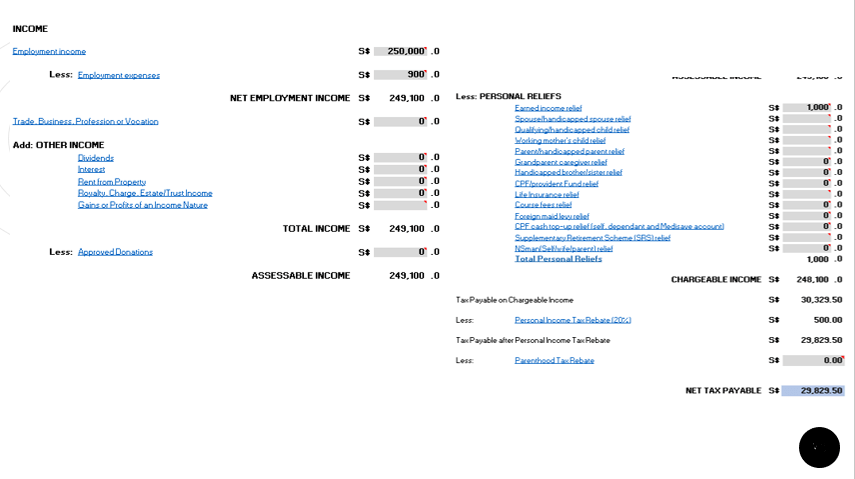
How does all of this look in terms of tax savings each year? Let’s take for example, a man on an EP who earns $250,000 a year. Say he claims $900 in tax on expenses. His original amount he should be paying on tax is $29,829.50

But let’s say he utilises all these tax reliefs he is eligible to, he will save about $10,547 per year on tax.

So you can see, this is a very substantial amount. SRS will give him a tax relief alone of $6.8k.

Here’s an example for someone on $100,000 a year. With all these tax reliefs, there a 4 and a half thousand dollar saving. Just on SRS alone that’s $3271 of savings.

Filing your taxes is so easy to do on the IRAS website, and with SRS being automatically calculated into your tax relief, all you really have to do is input your various other relief schemes. I think SRS in particular, is an excellent way for expats to plan for long term goals, such as retirement, whilst minimizing tax.

The Financial Impact of Russia’s Invasion of Ukraine

On the 24th February 2022, President Vladimir Putin announced a military operation in eastern Ukraine. Minutes later, missiles began to hit across the country, including its capital, Kyiv. Whilst I am seldom political on this page, I wanted to write on this topic, as there are massive global implications to this war. Already we have seen many world powers speak out against Russia, with sanctions being put in place, causing the Russian Ruble to plummet by 30% against the US Dollar.

  What implications will the war and the sanctions have on our global economy? Let’s take a look at a few.

Geopolitical Shock

As the whole world reacts to the conflict, and with more and more countries supporting Ukraine (the EU in particular), we have seen bans on flight paths to Russia, SWIFT being sanctioned and Russians being unable to access their bank accounts. We have yet to see fully how China will react but it has signalled a willingness to help Russia. If Beijing responds in a malign way, i.e., using this as an opportunity to go into Taiwan, geopolitical tensions are sure to grow further.

  When Russia invaded Ukraine, we saw the markets sharply drop, but it definitely could have been more extreme, and we actually saw markets bounce back trading to above what it was before the conflict started. Last week, the S&P 500 index logged its first correction in nearly two years, meaning it dropped more than 10% from its recent peak; and even though there was uncertainty about what was going to happen next, the US stock market bounced back quickly. Certainly, NATO and the EU’s response has stopped the market from freefalling.

  Do note, when investments start to tank, investors are tempted to sell and cut their losses. Don’t do this- a major reaction like this is more likely to hurt you more in the long run. The stock market is volatile, it is a part of investing…do not panic.

Energy

  Gas is a large commodity for Russia, and many European countries rely on Russia’s energy supply through vital pipelines. Sanctions on Russia may hinder these countries importing gas. We saw a surge in oil prices last Wednesday; Brent crude futures rose by more than $8, touching a peak of $113.02 a barrel, the highest since June 2014, before easing to $111.53, up by $6.56 or 6.3 per cent by 0950 GMT.

Food Supplies

Not only is crude oil affected, edible oil is too; Ukraine is a huge sunflower oil supplier and if the conflict continues, importers will struggle to replace supplies. Not only that, Ukraine and Russia combined account for 30% of the World’s export of wheat and 19% corn (the two countries also account for 80% of sunflower oil exports!). This means that these food supplies could be hindered, cut off and become incredibly expensive. And this is not the only price that has been driven up. Over the past month, inflation in Europe has jumped to 5.8%, and this conflict could send prices even higher.

Auto

This sector is set to be hit hard by the war; semiconductor sales to Russia are now banned, oil prices have gone up and Ukraine is home to many companies that manufacture car parts. Already we have seen Volkswagen have to close one of its plants in Germany, due to the knock-on effect of Ukraine’s part on its supply chain.

Confidence In The Market

Already we have seen how the war has affected many sectors and sent certain stocks plummeting- and this may want investors and individuals in general to become more cautious with their money. Some may react by saving more and spending less, leading to slower economic growth. People’s confidence will vastly depend on how long the invasion goes on for, and businesses that rely of Russia’s supply chain, such as electronics and automobiles, can be gravely affected.

Will There Be A Further Crash?

  For the last six US-involved wars, the stock market rose in the 10 years following the breakout of war. The Gulf War saw the market rise 500% over a 10-year period. If the entire stock market was to crash in every country it would mean that no businesses anywhere made any profit, and I think we can all agree this would mean that humanity was in a pretty dire situation, with larger problems than just the economy. It’s very difficult to predict what will happen next to the stock market, and we only have public knowledge to base our assumptions off of. If your investing horizon is long, the best thing you can do during times of crisis is to hold tight and keep investing as usual. The stock market has historically always bounced back, and you’ll be rewarded for keeping your reactions in check.

Whatever happens, all we can do is wait and see. Support in anyway you can. Check in with anyone affected by the war, and let us all pray this ends soon.

How Homer Simpson Beat Capitalism

  Anyone that knows me, knows that I love The Simpsons; it’s probably my all-time favourite show, I quote it almost on a daily basis and Homer Simpson is probably my most loved character. He means well, he’s hilariously ignorant and he has some of the best dialogue in the show. Not only that, Homer seems to have the most blissful life- where in some episodes, money is a huge worry (Lisa needs braces, Santa’s Little Helper needing surgery, Homer and Bart conning people to pay for Homer’s broken car), this is always resolved by the end of the episode and for the most part, Homer enjoys a great lifestyle full of relaxing, eating and drinking and going on holiday. So how did Homer do it? How did Homer Simpson beat capitalism?

  First, I’d like to discuss the Simpson’s house. 742 Evergreen Terrace is a pretty big home, with 4 bedrooms, a large garden, basement and attic. If you look at Homer’s annual salary (in Season 7 Homer opens the mailbox and complains that his pay is low) of $24,395 ($37,791.72 when adjusted for inflation), this doesn’t seem enough to run a large household with 3 kids on one salary. However, many people believe Springfield to be based on the Springfield in Oregon, where the median household income is $39,756, putting Homer in the lower middle class income bracket. Looking at this makes it a lot more plausible for the Simpsons to be living comfortably in this home. Not only that, like many Americans, Homer has had some help from his family. In Season 4, Episode 10, we find out that Homer had asked his dad, Abe, to give him $15,000 to buy a house. Abe sells his house (which he won on a 50s gameshow) and writes Homer a cheque.  These two factors make it pretty clear how the Simpsons can afford this house.

  Let’s talk about Homer’s job as a safety inspector at the nuclear power plant. We all know Homer hates this job, so surely capitalism has a firm grip over Homer in this sense? I disagree. First of all, Homer doesn’t have a university education; in Season 5, Episode 3 he is forced to go to university as he is unqualified for his job role. But in true Simpson’s fashion, the episode ends almost at a reset, with no degree earned and Homer still working at the power plant. He is able to continue working in a graduate-role, unqualified, where he sleeps most of the time at work, and leaves it up to other things (like a dog or a drinking bird toy) to do his work for him. He is literally being paid to do nothing, taking his salary from the personification of capitalism himself, Mr Burns- Take that! He even takes over from Mr. Burns in one episode, disproving the capitalist idea that the harder you work, the better your salary.

  This leads me onto my next point, Homer’s long resume. Take into consideration how many jobs Homer has had; astronaut, boxer, food critic, mob boss, inventor and missionary to name a few… these jobs have put Homer all over the economic spectrum. But the highest paying jobs all seem to be at the nuclear power plant where he currently works. His current job has funded his passion to be able to do whatever he wanted, with almost little to no experience and qualifications. Most people feel that capitalism has beaten them, as they are unable to pursue their passions, either because they don’t get paid enough, or they don’t have enough time around their 9-5. Not Homer…he follows whatever job he desires.

  Homer’s frivolous spending is also a common theme on the show. He’s bought a tonne of high-ticket items; a pool, a gun, a plough, Snake’s car, a caravan, a Tomaco Farm to name a few. Not only that, his constant blunders have cost the family a staggering estimated $333 billion dollars over the years (especially because of Bart not inheriting Mr Burns’ estate). This kind of bad money management would have sent most into masses of debt, spiralling down towards bankruptcy and an inability to move on. Not Homer Simpson- over the past 33 years, despite all of this, his income, living situations and conditions have pretty much stagnated, not making him worse or better off than he was before.

  If you’re an avid watcher of The Simpsons, like I am, you’ll know that they’ve travelled a lot. Not only have they visited many places in America, they’ve travelled to exotic locations such as Australia, Japan, Morocco, Italy and China. Most of these countries the average American would class as a once-in-a-lifetime trip, not a once-in-a-season trip like the Simpsons see. Since the show debuted in 1989, they’ve travelled to more than two dozen countries and about two dozen U.S. states. Considering that he’s a lower middle-class American, Homer’s travel history is enviable, and he definitely doesn’t let his monotonous 9-5 supress his holiday bug!

  I think the main (and final) point that proves that Homer triumphs in the battle against capitalism is comparing his life to other’s in Springfield. Did you know that Carl Carlson and Lenny Leonard both work in the powerplant and have college educations, but Lenny lives in a completely dilapidated home in comparison to Homer’s big house. Moe and Barney as portrayed as low-lives, with nothing much going for them, often envious of Homer’s life…even though he is an alcoholic just like Barney, but hasn’t frittered all his money away. I think the character that shows this contrast the most is Frank Grimes. Grimes was a colleague and self-proclaimed enemy of Homer. He is infuriated at the fact that Homer has it so good on little-to-no effort, but Frank has to slave away to make ends meet. This frustration leads to his demise (RIP Grimy). He saw Homer’s possessions as satisfying yet undeserved for an incompetent person like him; Homer had a comfortable life, a polite family, an adorable baby, a genius daughter, a beautiful wife, a son who owned a factory (at the time), a dream home, two cars, could afford lobster for dinner, won a Grammy, toured with the Smashing Pumpkins, was friends with Gerald Ford and had even been to space. In comparison, Grimes had to struggle for everything all his life, was working a second job at a foundry, and yet all he had to show for it was his briefcase, his haircut and a one-room apartment wedged between two bowling alleys (the latter of which impressed Homer). He declared Homer a “total fraud” who leeched off hard-working people like himself, being undeservingly rewarded for a lifetime of sloth and ignorance while he himself had few material possessions.

I’m saying you’re what’s wrong with America, Simpson. You coast through life, you do as little as possible, and you leech off of decent, hardworking people like me. Heh, if you lived in any other country in the world, you’d have starved to death long ago. You’re a fraud, a total fraud.

―Frank Grimes

I totally disagree with Frank Grimes Sr…Homer is proof that with the right mentality, we can overcome capitalism. Living life as a communist, socialist or hippy doesn’t beat capitalism, but Homer’s sheer indifference does; he has a wonderful home, family and leisure-life, funded by his less-than enthusiastic career, where he swindles a rich billionaire to pay him to do nothing. Homer is an icon.