Why Should Expats Open an SRS Account?

Half the year has already gone and it’ll be December before you know it. Therefore, I think now is a good time to start tax planning and looking into topping up your SRS account. In this article, I will be giving a brief overview of SRS, and why I believe it is an effective retirement and tax planning tool for expats in Singapore.

What is an SRS?

SRS stands for ‘Supplementary Retirement Scheme’, which you can think of as similar to CPF, with added benefits. This voluntary scheme is open to foreigners and locals, whereby anything inside this account is eligible for tax relief. In my opinion, not only is this a great way for saving for retirement, but it’s also one of the most effective ways to enjoy tax relief. There are a few other ways that expats can claim on their tax each year, such as life insurance relief, dependants relief and charitable donations. However, none seem to make a dent into tax savings as much as SRS.

You can open an SRS account with one of these three banks: DBS, UOB & OCBC. Opening the account itself is very simple and can be done via internet banking. In just five minutes, you can set up an account and deposit a maximum of $15,300 per year. However, this cap of $15,300 is just for PRs and citizens. If you want to increase your limit to the foreigner’s limit of $35,700, make an appointment at your bank and complete the relevant tax declaration form; you will then be able to add up to $37,500 into your SRS each year (provided you declare at the bank every subsequent year).

As of now, you can make penalty-free withdrawals from age 63, over a ten year period. But, take note, this number does change, so the longer you take to open your SRS account, the higher the retirement age may be. This account is for retirement, hence the long lock-in. However, not to worry, if you do wish to withdraw some money early, you may do so, it will just be taxable and a 5% penalty fee will apply. One thing that is good if you’re a foreigner and need to leave the country, is that you can withdraw in full penalty free, so long as your SRS account has been open for ten years.

Why is it good for foreigners?

One of the main benefits of SRS is the tax relief. Any monies that you deposit into this account is eligible for tax relief. You can check how much the savings are for someone of your income, you can download the tax calculator from the IRAS website. For those in the higher tax brackets, moving the maximum amount into SRS each year can knock a substantial amount off their tax bill, sometimes in the thousands.

Not only that, any withdrawal at or after the retirement age (over a ten year period) is only 50% taxable. This may not seem good, but remember that spreading out your withdrawals, instead of withdrawing lumpsum, will maximise your tax savings. Moreover, income of $20,000 or below is not taxable in Singapore; meaning that if you withdraw $40,000 a year from your SRS account, only 50% of that is taxable, which means that $20,000 would be taxable and the tax payable would be nil. Remembering key information like this will make your tax planning more robust.

Do remember that keeping your money in an SRS bank account only has an interest rate of about 0.05%, and we know that this is not going to keep up with inflation and may render your long-term savings useless. So what you can do is move your SRS money into approved investment vehicles. This means that you can still enjoy your yearly tax relief, the 50% taxable withdrawals, all while having your money grow better than bank rates, achieving you even higher returns with less tax!

We all know that investment is important, especially during times of high interest rate and inflation. The only way we are going to be able to survive retirement is if we plan and invest properly, instead of leaving it all in a bank account. SRS allows you to do that, whilst enjoying tax relief, now and in the future. And with the ability of opening an account with just $1, what’s stopping you?


Why is Singapore Buying Gold?

Back in January, MAS increased Singapore’s gold reserves by 30%, another 6.8 tonnes of gold, seeing a significant increase in our overall reserves to 205 tonnes. But why are they doing this? What is the reason?

Central banks are continuing to buy gold, instead of holding USD.  Belief is that, now, we are a multi-currency world, so gold is a safer asset to hold than American Dollars. Although USD won’t lose its currency reserve status anytime soon, central banks want to diversify away from the dollar.

The trend of diversifying away from the US Dollar gained momentum when Western nations began putting sanctions on Russia because of the war in Ukraine; Russia was kicked out of the SWIFT system and many other sanctions caused Russia’s economy to plummet.

Not only that, the US Dollar’s recent rise has caused massive inflation problems worldwide, especially for emerging markets. This has obviously worried banks, causing a shift to gold; gold is a good hedge against inflation, and is separate from currency, so does not suffer from exchange rate risks.

During times of political and economic uncertainty, gold is a safe reserve. Gold is able to retain value much better than other forms of currency, because it is limited and cannot be diluted. So to me, it is clear that Singapore is increasing its gold reserves due to the current economic climate; Singapore will be able to whether the financial storm we are facing right now.

Gold can be a good investment option right now, as it’s a good way to hedge against inflation and recession. If you hold cash, your money can be eaten away due to the poor interest rates vs inflation. And finally, while to US Dollar is likely to be the reserve currency for a while, we do not know what will happen in future. Will you be investing in gold, like Singapore?

Is It Worth Buying a Property in SG if You’re an Expat?

I think about this question a lot, as we all know the rental rates in Singapore have skyrocketed recently, and it pains me to pay more for rent than what some of my local colleagues pay for their monthly mortgage instalments. So I often think whether it is worth buying a property as a foreigner. However, there are many restrictions and extra costs involved are often put expat off buying property. Or, we can only buy private condominiums or landed property if it is in Sentosa. HDBs are completely out of the question, which, of course the more affordable option.

So let’s take a deep dive into whether it is worth an expat buying a property here.

One thing that does bring some foreign investors into buying property. Here is how stable and strongly Singapore dollar is. Even during the pandemic, the Singapore dollar continues to be stable, unlike some currencies in Europe and the US.  Last year, in 2022, foreign buyers made up 22.4% of all condominium sales in Singapore. This was quite a shock to me when I found this out, because Additional Buyer’s Stamp Duty (ABSD) for foreigners is at a staggering 30%! 

For example if I was buying a condo, as an expat, at S$1M my total Buyer’s Stamp Duty would be $24,600. Then my ABSD would be $50,000. So in total my costs for this condo would be $1,074,600! That’s a lot of extra cash to put down. And this isn’t even taking into account legal fees and other admin costs!

(Note that if you’re from the States, Iceland, Liechtenstein, Norway, or Switzerland, you don’t have to pay ABSD!)

In a lot of other countries, it’s very popular to flip your properties as a form of side income, or to do as a full-time business i.e., buying a property and selling it very quickly for a profit.

But in Singapore, if you plan to sell your home within the first three years of purchase, you will have to pay Seller Stamp Duty (SSD), which is 12% in the first year, 8% in the second and 4% in the third, so I think twice if you want to start being a home, flipper in Singapore! Your business may not be as lucrative as you think. 

Now, I think that a lot of expats don’t know in Singapore, is that we can actually apply for mortgages, normally with no issues. Usually the ratio is 75%, but can be as low as 55%. Do take note that the cash down payment is usually anywhere between 5% to 10%. However, although it doesn’t sound too bad, remember that interests are not exactly in our favour right now; you’re looking at our interest rate of about 3.65% – 4.25%, which means that if you are wanting to purchase $1 million property, your mortgage repayments could easily be around $7000 a month.

Looking at these numbers, I can look at it from both sides of the coin; this mortgage repayment is what a lot of people are paying as their monthly rental in Singapore. So if you are planning to stay in Singapore long-term, it’s actually a good investment because the property belongs to you, it’s not like you’re lining the pockets of a landlord by paying this in rent. But, if you’re only here short-term, perhaps it’s best just to suck up the large rental amount! 

The last thing I want to talk about, is the longevity of your home in Singapore. Unlike many other countries, whereby when you buy the property, it is yours forever, and you can use it as an ancestral property to pass down to your children et cetera, this may not be the case in Singapore. Most properties here are 99 year lease, including a lot of condos. Looking at PropertyGuru, it’s very difficult to find condos nowadays that are freehold. What I mean by this, is that it is owned by the buyer for life; it can be passed down generation to generation. If the property is a 99 year lease, then in theory, it has to be given back to the government after the 99 years is up. Not only does this mean that the property cannot be passed down multiple generations, but it also means that as a property becomes older, it can often lose its value, because buyers in the market know that at some point, it will have to be returned to the government. In my opinion, this is one of the reasons why a lot of expats are put off buying in Singapore. But now we see a lot more countries adopting this concept, especially with over population. And to be honest, I don’t think I would want to give my future generations an old dilapidated apartment, anyway. The buildings here are not like back at home, where they can last for hundreds of years, so to me, this is not much of an issue. If anything, I think it encourages the property market. It means that once the three years & SSD is up, you can sell your property and get a new one and upgrade.

So it’s kind of like a long-term flipping process. Instead of staying in one property that may become very rundown.

If I were to conclude on my thoughts as to whether it’s worth a foreigner buying a property here in Singapore, there are a few things. I do think it is worthwhile if they are planning on staying long time in Singapore, also because in future this could look good on their PR application as they are already rooted in Singapore. Moreover, I always think it’s good to be paying for your own asset, instead of paying rent to a landlord! And with rentals being crazy prices right now, it works out to be more cost-effective if you are going to be staying here in the long run, even with the additional taxes and stamp duty. However, if you’re wanting to use it as an investment property, and don’t really have intentions of staying long-term in Singapore, then it may be a better idea to look for properties elsewhere. Nearby Southeast Asian countries have less regulations in terms of the costing for foreigners, and the properties are larger and much more affordable, meaning you can turn that into a nice passive income for rental.

These are just my opinion is but what do you think about buying a property in Singapore as a foreigner? 

What Is Going On With The Banks In The US?

It’s been all over the news over the past couple of weeks that it’s not good news for certain banks in America, particularly Silicon Valley Bank, which announced its bankruptcy last Friday. Well this may not affect us directly, it’s very good to know what happened and of course why.

Silicon Valley Bank catered to many tech investors in the US, hence the name. It was taken over by federal regulators on Friday, leading to the largest bank sale in the US since the global financial crisis of 2008. Following this bank’s collapse, was New York’s Signature Bank on Sunday also collapsing, for different reasons due to its exposure to the crypto market. As you can imagine, the news of these led to a bank run last week, where depositors rushed to withdraw all their deposits from the bank. This inevitably led to the bond market swinging wildly, but why did this happen in the first place?

Like the age old saying, what must go up, must come down, and this is true in this situation. Catering to mainly tech developers and companies, Silicon Valley Bank boomed during Covid, deposits totaling over US$100 billion. Then, in 2021, when interest rates hit a record low, this bank invested billions of dollars into US Treasury bonds. Whilst bonds are generally safer investments, with steady gains, they only pay out in full if held to the maturity date. This poses a risk to bond investors if interest rates rise.

Lo and behold, we all know what happened-interest rates went up. This meant that Silicon Valley Bank had to sell at a loss. Not only was this a problem but it happened to come along with the whole tech sector bubble apparently bursting! We’ve all heard in the news and experienced friends, colleagues and family members possibly losing their jobs in the tech sector. Tech companies have been increasingly withdrawing their money from the bank. In order to comply with these withdrawals, SVB had to sell its bond holdings, at the loss of US$1.8 billion. Not only that, SVB also announced that it would be selling more of its shares, a hint that they require more cash! This shook its customers, causing even more people to withdraw from the bank.

On Thursday, customers at this bank try to withdraw 42 billion USD in deposits and the banks shares dropped more than 60%. By Friday, it was all over the Silicon Valley Bank.

While not all banks are in this niche of only catering to tech companies, this did spark concern about the banking sector, especially when the second bank, New York’s Signature Bank, collapsed on Sunday. This actually has had a knock on effect to more traditional banks; JP Morgan is down more than 7%, with Wells Fargo and Bank of America down more than 15%. Many bank analysts have stressed that there is no liquidity crunch facing the banking industry and that, it is more so a human fear that has gripped the market, and a self-fulfilling prophecy has been played out.

Luckily, those that had ties with the banks that have gone bankrupt, will have full access to their deposits, even those that exceed the limit of FDIC insurance. So at least there is some relief there for their customers.

President Biden remarked that the banking system is safe, but the markets did react strongly on Monday; we saw the US stock exchange go up and down with immense volatility over the course of the day. Not only that, government bonds yielded lower than expected. But the main thing that we must look out for is whether this will have any effect to the Fed’s decision next week…

The Federal reserve will meet next week to discuss whether it will raise its benchmark interest rates yet again. The rising interest rates have helped to slow inflation, but it has also devalued bonds and has somewhat led to the collapse of banks such as SVB. Hopefully, the Fed realises that if it continues to rise interest rates, more banks could fall victim. This might put the Fed under some pressure to ease the increases.

What does this mean for us in Asia? Well, luckily we may not be directly affected. For me personally, I see this as an opportunity to go into bonds when they are at a low. Generally, when equities are down, bonds are up. We have seen equities go down for Long time in the market now, which I hope means that bonds, after this little blip, will continue to go up. Of course, I cannot predict the market but I always see these kinds of situations as a great opportunity!

FIRE Movement; What’s it all about?

The term ‘FIRE’ seems to be all over the news lately, what is the hype and what does it mean?

FIRE stands for ‘Financial Independence, Retire Early’, and this is a movement that we’re seeing as of late, whereby people are leaving the workforce as early as they possibly can. They do this by focusing on scrimping and savings as much as they can now, in order to save the maximum amount for their retirement. This means cutting down on all unnecessary expenses; eating out less or almost never, not taking any holidays, even working a part-time job on top of full-time employment to earn extra income, and using all of the surplus cash to stringently invest and save. This can be quite extreme; leaving the workforce early is maybe one of the biggest financial decisions of your life, so you need to make sure you have planned correctly.

There are actually a few kinds of FIRE, which I will delve into in this article.

Fat FIRE

If you like the idea of retiring early, but don’t want to drastically alter your lifestyle to the point where you never go out or do anything fun, then Fat FIRE might be a method that interests you. Fat FIRE appeals to those who cannot keep their expenses low; if you have a family you need to pay for education, schooling, groceries, school uniforms etc., which are often difficult or impossible to trim (you can’t ask your kid’s school to lower their fees, for example). So how do you achieve FIRE with higher expenses? The answer, a higher income. Fat FIRE only works for higher income earners that choose not to fully embrace frugality. You can see this may not be for everyone- getting a higher income is easier said than done as may require certain experience, knowledge, education and so on, that might not be applicable to all.

Barista FIRE

This FIRE movement does just what it sounds like; working part time (in a café or otherwise) to supplement your retirement income. This might work for a lot of people; even I myself don’t want to do nothing during my retirement. Getting paid to do a passion-project as a free-lancer sounds like an awesome way to spend my time. This method of FIRE means that you don’t have to completely cut out all lifestyle expenses during your working years, as you know that there will be a part-time income rolling in throughout retirement. This is contrary to the next FIRE method…

Lean FIRE

Lean FIRE Method is really the extreme, hardcore or by-the-book method. Lean FIRE means you really live that minimal lifestyle right into retirement. This includes tactics like bringing your own water bottle and packed lunch with you when you’re out, taking public transport or walking from point A to point B and downgrading your rent by renting out a single room instead of a whole unit. Even someone on a lower income can practice Lean Fire, and put their monthly surplus into savings and investments. This method of FIRE really reminds me of the show ‘Extreme Cheapskates’.

Coast FIRE

In my opinion, Coast FIRE is the most realistic and less extreme method; it’s actually quite similar to the advice I give my clients; invest early and as much as you can, and enjoy the compound interest later in life. The earlier you start investing, the better; you have a longer runway and more time for that interest to accumulate. Holding your investments longer also means that you are able to tolerate volatility in the stock market.

FIRE can be studied in depth and is an interesting movement. Later on, I will explore further as to whether this method is sustainable. But, what do you think? Will you be practising FIRE any time soon?

How Influencers Are Ruining Your Idea Of Investment

I wanted to write this article because I’ve been seeing lots of posts on Instagram (mostly) of influencers promoting different investments, often suggesting they have made a lot of money using them (and it’s mostly involving crypto), and I have a problem with that.

  Social media influencers have boomed in the past few years and, what was once a farfetched and trivial job is now a very feasible full-time career that many are choosing to pursue. People can now make a living by posting review video and content…especially if those reviews are sponsored. A recent study showed that 37% trust the opinion of social media influencers over brands, with Gen Z and Millennials twice as more likely to trust influencers over Boomers. I think that this statistic isn’t shocking or dangerous overall; watching reviews of products you are thinking of buying is a good way of practising your own due diligence. But it’s when paid promotions of investments start cropping up where it becomes an issue.

  Speculation is a term used in investing, whereby groups of people try to guess how a trend, portfolio, or stock will perform in the future, normally with just surface-level knowledge or research. This investment strategy is very risky and can be a factor to why monumental crashes (like the Great Depression) happen. If you watch any influencer’s video that is promoting a particular investment, trading platform, NFT or cryptocurrency, you will start to notice speculation. They will start hyping the investment up, usually stating that it has earned them X amount of money in a short period of time, or make bold claims that it will continue to grow, despite market conditions being down. This is incredibly dangerous for young, impressionable consumers, who trust whatever product these influencers are selling.

  The truth is, yes, these investments have probably made these influencers money…because they have been paid to talk about it. It is highly unlikely that they themselves invest or trade the product they are pushing, on a regular basis. Or worse, they may be using a pump and dump method; whereby them hyping up the investment may make lots of people buy, and drive prices higher. They then have the opportunity to cash out, making money for themselves but making the stock crash, leaving you, the consumer, sat with a bad investment that’s lost you money.

  Believing these kind of posts and videos are so dangerous because usually the influencer does not have enough knowledge to be promoting such a product. These products are normally a lot riskier than most people’s risk appetites, and the influencer is probably unaware of all the fine print. In all honesty, the only people that should be giving advice on financial services are licensed professionals, and even then, it is not a one-size-fits-all situation. A doctor wouldn’t go on YouTube and tell everyone to start taking antibiotics, regardless of whether they are sick or not. The same goes for a financial advisor. Any videos giving financial advice should be taken with a pinch of salt; not everyone’s finances are going to be planned the same way and not everyone is going to be investing in the same thing. Investing should be tailor made to the individual, based on goals, time frame, budget and risk appetite.

  Of course, I’m not saying that any social media influencer that posts this sort of stuff is a bad person (everyone needs to get paid), but be cautious when you watch people pushing investment strategies that they are probably not implementing themselves. If in doubt, always ask a professional.

How Will Inflation Affect Your Long-Term Planning?

We’re all been hearing about how bad inflation is and that it’s increasing etc. But what does this actually mean and how does it have a lasting affect on our money planning?

What Is Inflation?

Simply put, inflation is when the cost of goods and living increases. Whilst some see this as a bad thing, slight inflation is good as it is a sign of a growing economy; meaning more employment, higher profits and an increase in production. But, right now, we are seeing a significant rise in inflation. In December of 2021, Singapore saw inflation hit a 9 year high of 4%.

How It Affects Us Now

This increase directly affects us, and you may have even felt a bit of a pinch. Food is a bit more expenses and energy prices seem to have gone through the roof. All of this means that your cold hard-earned cash has less spending power, essentially meaning that you cannot buy as many things with the same amount of money as you used to. What further exacerbates this problem is bank interest rates; most current accounts in Singapore have an annual interest rate of 0.05%, meaning the bank gives you that much extra each year (not a lot at all). If current inflation rate is at 4%, you are losing 3.95% of your money every year by just leaving it in your bank account! This means that whilst you are earning money, not only are things getting more expensive but you’re losing money in your bank account too!

How It Affects Our Future

As you can imagine, this situation has a massive knock-on effect for our futures. If inflation increases, or even plateaus at say about 2%, you are still losing money in your bank account. Food, housing, medicine and energy will continue to go up in price, meaning each year you will either be able to afford less, or have to spend more to keep up. Not only that, your savings will not be as powerful as it once was…so you can see how this is a problem two-fold!

How Can We Stop This?

But fear not! If we prepare now ahead of time, we can manage inflation so that it doesn’t eat away at our savings. There are a few things you can do in preparation: first, include inflation in any planning you do. Want to save up for a holiday in 5 years’ time? Inflate your ticket and hotel prices by at least 2% per annum (3% if you want to be safe). Secondly, consider using vehicles and instruments that will offer you higher returns than your current bank account- any % higher than current inflation rate will give you a positive yield, and will ensure that your savings don’t run dry. I also think it’s best to create multiple avenues for growing your money, so that if one option is not doing well, at least you have money in different areas that you can withdraw from. Lastly, do not underestimate how much different sectors will increase. Food, healthcare, housing etc. do not always follow the same trend or inflation rate. Ensure you have medical expenses covered and calculated into your long-term planning, as well as remembering that your income will not go as far in future unless you ensure there are increases.

Essentially, it is best to start planning now instead of panicking later on in life, realising that you could have prepared for inflation but didn’t. As always, it’s best to stay in-the-know, and consult a professional when it comes to your financial planning.

Why Did Crypto Crash?

  It seems that we can’t catch a break this year, markets are down, there’s a war, inflation is up, and now the value of cryptocurrency has plummeted, leaving many feeling disheartened with their investments. But, why did it happen? It’s actually a much broader picture. Let’s do a deep dive…

Inflation

  The first thing that triggered the crash was investors losing confidence in cryptocurrency and fearing the rise in inflation; inflation has been rising the past few months and apparently has not reached it’s peak yet! This is somewhat due to customer demand after the pandemic, along with Russia invading the Ukraine.

Interest Rates

  The Federal Reserve raised its benchmark interest rate by 0.75%, which has been the biggest increase since 1994. This has had a massive impact on the crypto market. Interest rates make debt more expensive and negatively affect the economic climate; it can decrease the value of asset classes, particularly stocks and of course…cryptocurrency.

Stock Market

  As I previously mentioned, the hike in interest rates and inflation has massively affected the stock market; recently the S&P 500 decline has been even worse than at the height of the pandemic, as it dropped 5.8%. All these factors indicate a global recession is coming, and usually during bear periods, higher risk assets, including crypto, take a hit.

High Yields Were Promo Rates

  Many crypto platforms, such as Celcuis, offered returns of 18% and some platforms even more. These rates of returns are even higher than that of the stock market and could not be sustained year upon year for a long period of time- some were merely promo offers to get their platform some buzz and traction. Many people thought that this was a risk-free yield…definitely not the case! That 18% had to come from somewhere, essentially a borrower, and when more people want to gain these returns instead of borrow…that’s when problems arise.

Energy Crisis

  I’ve already mentioned the Russian-Ukraine crisis but the knock-on effects of the energy crisis have taken its toll on crypto too. If you’ve read my previous articles on cryptocurrency and the environment, you’ll know that mining crypto coins uses up a hell of a lot of energy. The cost of electricity has massively gone up since the Russian sanctions were put in place, meaning that it costs a lot to mine coins. This lowers the profit margins of the cryptocurrencies, depreciating their value.

In Summary

  To summarise, it was not just cryptocurrency that took a hit during this period; global markets are down, and many people are feeling the pinch. Rising living costs often leaves less disposable income for other things, including investment. But remember, historically bear markets (when the market is down) last on average for about 12 months, whereas a bull market on average lasts for 2.7 years…so the good times are mostly longer than the bad.

  One thing to remember is that cryptocurrency is unregulated and financial authorities cannot step in if anything goes wrong. This makes it a higher risk investment; remember that before you invest.

Tax Relief For Foreigners

It’s tax filing season, and a lot of expats here in Singapore don’t know that they’re eligible to certain tax reliefs. Today I’ll be talking about how you can legally save on your taxes in Singapore. Just a disclaimer, My job isn’t tax planning, I’m a financial consultant, but these are some things that I do and have researched, that you can put into practice. And of course, this is just for Singapore. I know about some tax laws in other countries but I’ll just be talking about Singapore today.

I want to do a quick overview of the tax system in Singapore, tax reliefs available here and a bit of an example of SRS savings. So you may be shocked as to how many expats are in Singapore. It’s actually approximately 1.68 Million. So quite a lot, but 1 in 8 lost their job in 2020. While job security is a worry to most of us, at least Singapore is doing quite well when it comes to dealing with Covid. And unemployment rate is definitely not as high as other countries during this crisis. There are also many affluent citizens and residents here. Tax, whilst low in Singapore, can still take away a large chunk of your salary.

For tax in Singapore, the amount you pay is broken down into various brackets. Singapore is seen as one of the top first world countries for having low tax, it’s somewhat of a tax haven, but you can see that if you are in the higher income bracket, for example $200k and above, your tax for the year is quite substantial.

So, how can we legally minimise the amount of tax we are paying each year?

There are several things that can give you tax relief. This may appeal more to those that plan on staying here long term, or even longer than just a couple of years, as all these reliefs add up in the long run.

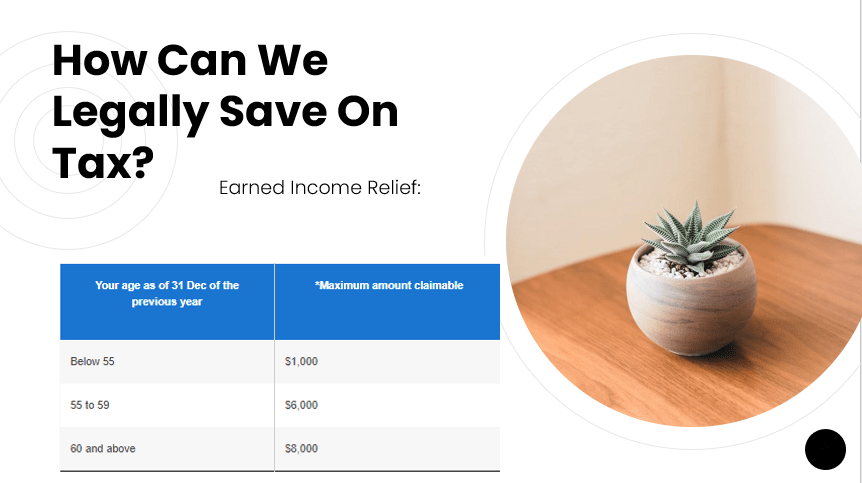
The first and easiest tax relief you can get is employment relief. This is automatically calculated into your tax and is capped at $1,000 for below 55. And then it goes up depending on age bracket.

Next is life insurance relief. If you have any insurance policies from an insurance company in Singapore, you are entitled to a relief of maximum $5,000 per tax year, provided the insurance is for yourself, and is not an accident or hospital policy, or a pure investment policy. This relief can be filed at the end of the tax year under e-filing.

If you have anyone here with you on a dependent pass and they’re not working, you can claim for tax relief. You are entitled to claim $2,000 for spouse, $4,000 for child and $9,000 for a parent on a DP.

To me, this is the most effective way to save on taxes. SRS scheme is great because not only does it offer you tax relief, but you can also make use of the money inside and grow that money for a retirement plan. And, what’s great is it’s available to expats, it’s actually more flexible for expats. Singaporeans can put $15,300 into SRS each year and expats can put $35,700. Just note that if you want to put this maximum amount in, you have to go to the bank and declare that you’re a foreigner.

Everything inside this account is eligible for tax relief, which is done automatically. After the retirement age, you can make withdrawals from this account penalty free. Before that, there’s a 5% charge. The great thing about SRS is after the retirement age, anything that you withdraw from the account, only 50% of it is taxable.

So what can we do with the money inside the account? Well, seen as the interest rate in an SRS account is about 0.05%, I would recommend putting it somewhere where it can grow more, so, if you leave Singapore or you decide to retire here, you’ve got a huge lump sum waiting for you. As you can imagine, if you are putting the maximum amount each year into SRS, you can have a very good pot of cash at the end.

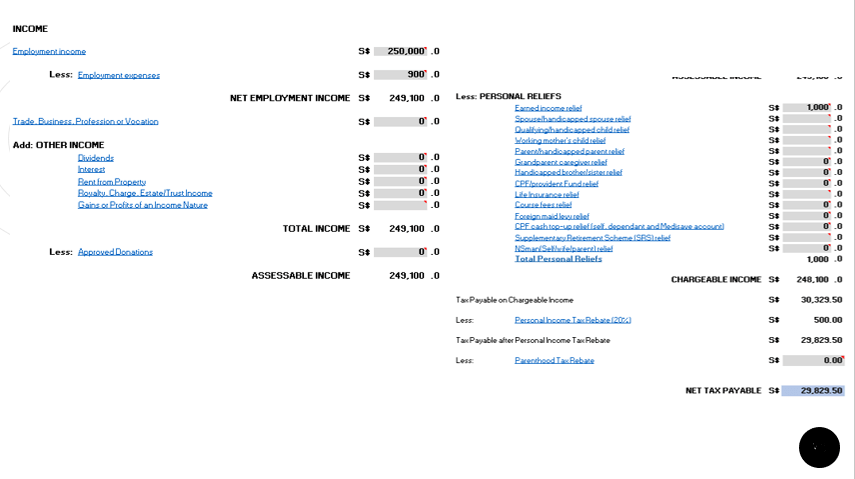
How does all of this look in terms of tax savings each year? Let’s take for example, a man on an EP who earns $250,000 a year. Say he claims $900 in tax on expenses. His original amount he should be paying on tax is $29,829.50

But let’s say he utilises all these tax reliefs he is eligible to, he will save about $10,547 per year on tax.

So you can see, this is a very substantial amount. SRS will give him a tax relief alone of $6.8k.

Here’s an example for someone on $100,000 a year. With all these tax reliefs, there a 4 and a half thousand dollar saving. Just on SRS alone that’s $3271 of savings.

Filing your taxes is so easy to do on the IRAS website, and with SRS being automatically calculated into your tax relief, all you really have to do is input your various other relief schemes. I think SRS in particular, is an excellent way for expats to plan for long term goals, such as retirement, whilst minimizing tax.

The Financial Impact of Russia’s Invasion of Ukraine

On the 24th February 2022, President Vladimir Putin announced a military operation in eastern Ukraine. Minutes later, missiles began to hit across the country, including its capital, Kyiv. Whilst I am seldom political on this page, I wanted to write on this topic, as there are massive global implications to this war. Already we have seen many world powers speak out against Russia, with sanctions being put in place, causing the Russian Ruble to plummet by 30% against the US Dollar.

  What implications will the war and the sanctions have on our global economy? Let’s take a look at a few.

Geopolitical Shock

As the whole world reacts to the conflict, and with more and more countries supporting Ukraine (the EU in particular), we have seen bans on flight paths to Russia, SWIFT being sanctioned and Russians being unable to access their bank accounts. We have yet to see fully how China will react but it has signalled a willingness to help Russia. If Beijing responds in a malign way, i.e., using this as an opportunity to go into Taiwan, geopolitical tensions are sure to grow further.

  When Russia invaded Ukraine, we saw the markets sharply drop, but it definitely could have been more extreme, and we actually saw markets bounce back trading to above what it was before the conflict started. Last week, the S&P 500 index logged its first correction in nearly two years, meaning it dropped more than 10% from its recent peak; and even though there was uncertainty about what was going to happen next, the US stock market bounced back quickly. Certainly, NATO and the EU’s response has stopped the market from freefalling.

  Do note, when investments start to tank, investors are tempted to sell and cut their losses. Don’t do this- a major reaction like this is more likely to hurt you more in the long run. The stock market is volatile, it is a part of investing…do not panic.

Energy

  Gas is a large commodity for Russia, and many European countries rely on Russia’s energy supply through vital pipelines. Sanctions on Russia may hinder these countries importing gas. We saw a surge in oil prices last Wednesday; Brent crude futures rose by more than $8, touching a peak of $113.02 a barrel, the highest since June 2014, before easing to $111.53, up by $6.56 or 6.3 per cent by 0950 GMT.

Food Supplies

Not only is crude oil affected, edible oil is too; Ukraine is a huge sunflower oil supplier and if the conflict continues, importers will struggle to replace supplies. Not only that, Ukraine and Russia combined account for 30% of the World’s export of wheat and 19% corn (the two countries also account for 80% of sunflower oil exports!). This means that these food supplies could be hindered, cut off and become incredibly expensive. And this is not the only price that has been driven up. Over the past month, inflation in Europe has jumped to 5.8%, and this conflict could send prices even higher.

Auto

This sector is set to be hit hard by the war; semiconductor sales to Russia are now banned, oil prices have gone up and Ukraine is home to many companies that manufacture car parts. Already we have seen Volkswagen have to close one of its plants in Germany, due to the knock-on effect of Ukraine’s part on its supply chain.

Confidence In The Market

Already we have seen how the war has affected many sectors and sent certain stocks plummeting- and this may want investors and individuals in general to become more cautious with their money. Some may react by saving more and spending less, leading to slower economic growth. People’s confidence will vastly depend on how long the invasion goes on for, and businesses that rely of Russia’s supply chain, such as electronics and automobiles, can be gravely affected.

Will There Be A Further Crash?

  For the last six US-involved wars, the stock market rose in the 10 years following the breakout of war. The Gulf War saw the market rise 500% over a 10-year period. If the entire stock market was to crash in every country it would mean that no businesses anywhere made any profit, and I think we can all agree this would mean that humanity was in a pretty dire situation, with larger problems than just the economy. It’s very difficult to predict what will happen next to the stock market, and we only have public knowledge to base our assumptions off of. If your investing horizon is long, the best thing you can do during times of crisis is to hold tight and keep investing as usual. The stock market has historically always bounced back, and you’ll be rewarded for keeping your reactions in check.

Whatever happens, all we can do is wait and see. Support in anyway you can. Check in with anyone affected by the war, and let us all pray this ends soon.