With the recent unveiling of the UK Autumn Budget 2024, significant changes to personal and corporate tax regulations are set to reshape financial landscapes for individuals and businesses alike.
In his latest write-up, Peter Webb, our expert technical consultant delves into the nuanced details of these tax adjustments, providing clarity on what to expect moving forward. From adjustments to income tax thresholds to corporate tax rate modifications, understanding these changes is crucial to effective financial planning.
Join us as we explore the implications of this budget on your financial strategy and what it means for the future of taxation in the UK.
“Personal
Rates of income tax and National Insurance (NI) paid by employees, and of VAT, to remain unchanged
Income tax band thresholds remain frozen until 2028
Basic rate capital gains tax on profits from selling shares to increase from from 10% to 18%, with the higher rate rising from 20% to 24%
Rates on profits from selling additional property unchanged
Business Asset Disposal Relief tax rate to rise to 18% over the next 2 tax years
Business Relief and Agricultural Property Relief will be limited to £1mn from April 2026 with 50% IHT relief above that limit
IHT relief on AIM shares to be limited to 50% (ie eective 20% IHT rate)
Stamp duty surcharge, paid on second home purchases in England and Northern Ireland, to go up from 3% to 5%
Point at which house buyers start paying stamp duty on a main home to drop from £250,000 to £125,000 in April, reversing a previous tax cut
Threshold at which first-time buyers pay the tax will also drop back, from £425,000 to £300,000
5p cut in fuel duty on petrol and diesel brought in by the Conservatives, due to end in April 2025, kept for another year
Basic and new state pension payments to go up by 4.1% next year due to the “triple lock”, more than working age benefits
Inheritance tax threshold freeze extended by further two years to 2030, with unspent pension pots also subject to IHT from 2027
Business
Companies to pay NI at 15% on salaries above £5,000 from April, up from 13.8% on salaries above £9,100, raising an additional £25bn a year
Employment allowance – which allows smaller companies to reduce their NIC liability – to increase from £5,000 to £10,500
Tax paid by private equity managers on Carried Interest to rise from up to 28% to up to 32% from April
Main rate of corporation tax, paid by businesses on taxable profits over £250,000, to stay at 25% until next election”
We encourage our readers to engage with us on this topic. If you have questions about how these budget changes may affect your personal or corporate tax planning, or if you need expert advice tailored to your specific circumstances, please don’t hesitate to reach out. You can connect with Peter & I through the comments section below or contact us directly at peter.webb@sjpp.asia. Your financial well-being is our priority, and we’re here to help you navigate these changes effectively!
If you’re living abroad, you may face unique challenges and opportunities when it comes to securing your financial future. In this episode, we’ll explore effective strategies for long-term financial security and specifically look at the benefits and considerations of offshore investments.
Understanding the Expat Landscape
Living as an expat often means navigating a complex financial and legal landscape. Here are some key aspects to consider:
Varied Legal Obligations: Different countries have different rules regarding taxes, social security, and retirement benefits. Understanding these policies is crucial, as they affect how you save and invest for retirement. (https://danielleteboul.com/2022/04/04/tax-relief-for-foreigners/)
Assess Your Current Financial Situation: Take stock of your assets and income. Understand your expenses both currently and in retirement.
Set Clear Goals: Determine the lifestyle you envision in retirement. This will help you gauge how much you need to save.
Diversified Investments: As an expat, ensure that your investment portfolio is diversified not just geographically but also across different asset classes. This can help mitigate risk.
Emergency Fund: Build an emergency fund that covers at least 6 to 12 months of living expenses, as needs can arise unexpectedly, especially in a foreign country.
Now, let’s delve into offshore investments and why they may be a good option for expats looking to secure their retirement.
Tax Efficiency: Many expats can benefit from offshore accounts that offer tax shelters or incentives. However, it’s vital to ensure compliance with both local laws and FATCA regulations if you’re a US citizen.
Access to Global Markets: Offshore investments provide an opportunity to access international markets that might not be available to you in your home country.
Currency Diversification: Holding assets in multiple currencies can protect you from currency fluctuations that might impact your purchasing power in retirement.
Estate Planning: Offshore structures can aid in estate planning, ensuring that your assets are passed on according to your wishes while potentially minimising tax liabilities.
Seeking Professional Guidance
Given the complexities of retirement planning as an expat, working with a financial advisor who specializes in expat financial solutions is highly advisable. Here’s what to look for:
Experience with Expat Financial Issues: Choose an advisor familiar with the tax laws and retirement regulations of both your home country and your country of residence.
Trustworthiness and Credentials: Ensure they have the right qualifications and are certified by recognised financial regulatory bodies. In Singapore, this is MAS.
Transparent Fee Structures: Look for advisors with clear fee structures so you know exactly what you’re paying and what services you’re receiving.
In conclusion, retirement planning as an expat involves understanding the unique challenges and opportunities you face. By assessing your situation, setting clear goals, diversifying your investments—including considering offshore strategies—and seeking professional guidance, you can create a plan that ensures long-term financial security.
The Central Provident Fund is a mandatory savings scheme that supports Singaporeans in retirement, healthcare, and housing. Established in 1955, it functions as a comprehensive social security system, whereby both employees and employers contribute a percentage of the employee’s salary to various accounts.
The Different Accounts
CPF is divided into three main accounts, each serving specific purposes:
Ordinary Account (OA):
Primarily used for housing, education, and investment. Funds in the OA can be utilised for purchasing homes, paying for CPF-approved housing loans, and education expenses.
Special Account (SA):
Aimed at retirement savings, this account offers higher interest rates. Savings in the SA can only be withdrawn at age 55 and are primarily meant to support old age.
Medisave Account (MA):
Designed for healthcare expenses. Contributions to the MA can be used for hospitalisation, outpatient treatments, and various health insurance premiums. This account helps ensure that Singaporeans are covered for medical needs throughout their lives.
Retirement Sums
The CPF system is engineered to ensure that Singaporeans have sufficient savings for their retirement. As of 2023, the Full Retirement Sum (FRS) is set at SGD 198,000 for those turning 55. Those who wish to enjoy a higher monthly payout can opt to set aside a higher sum under the Enhanced Retirement Sum (ERS), which stands at SGD 297,000.
To qualify for the various retirement schemes, it’s crucial to meet these sums by the time you reach retirement age. The CPF LIFE scheme further guarantees a lifelong monthly payout, allowing members to enjoy peace of mind during their retirement years.
Is it Worth Topping Up Your CPF?
Many may wonder if topping up your CPF, beyond the mandatory contributions, is worthwhile. Here are a few considerations:
Higher Interest Rates: The CPF accounts offer guaranteed interest rates that can go up to 5% for the first SGD 60,000 of combined balances. This is attractive compared to many saving accounts available in the market.
Tax Benefits: Contributions to the Special Account or MediSave Account may qualify for tax relief, reducing your taxable income and offering additional savings.
Future Financial Security: By topping up your CPF, you boost your retirement funds, ensuring a more comfortable lifestyle in your golden years. The compounded interest on these savings can significantly accumulate over time.
However, it’s essential to balance your current liquidity needs with long-term savings. CPF funds are not retrievable until you reach retirement age.
In summary, the CPF is not just a savings tool; it’s a comprehensive financial framework designed for Singaporeans to support their retirement, health, and housing needs. Understanding the different accounts and contributing to them can significantly enhance your financial security. Whether you’re considering topping up your CPF or just starting your savings journey, remember the long-term benefits it provides.
If you found this information helpful, consider sharing it with friends and family who may also benefit from understanding CPF better. Until next time, stay financially savvy!
Despite the doom and gloom you might hear in the news, the world economy is showing some grit, holding its own. This has given central banks a bit of wiggle room to tweak interest rates, which is good news for stocks, though not so much for gold. However, with the political scene being a tad unpredictable, gold remains a hot ticket item.
All That Glitters: Gold Market Buzz
The gold market is shifting gears. Its focus is moving from Chinese investment and central bank purchases towards anticipation of interest rate drops in Western economies. Gold prices are soaring, especially after the European Central Bank’s second rate cut. Traders in the futures market are hopeful, expecting lower interest rates, and the physical market is buzzing with investors seeking safer options.
However, history teaches us that interest rate cuts alone don’t guarantee a gold price surge. In the past, gold usually climbed only if rate cuts led to a recession, averaging a 15.5% increase within a year. If there was no recession post-cuts, gold prices typically fell by around 7%.
Stock Market Standouts
US stock markets have generally done well when the Federal Reserve cuts rates, especially if there’s no subsequent economic slump. Since the 1980s, the S&P 500 has averaged a 14.2% return in the year after initial cuts, outperforming the average return of 10.4% over the same period. This suggests that lower interest rates, without a corresponding recession, usually make for a good stock market environment.
While the economic backdrop looks positive, market ups and downs may persist due to uncertainties around the upcoming U.S. election and concerns of economic slowdown. However, these fluctuations might be a blip in a larger upward trend. So, long-term investors might want to keep their eye on U.S. large-cap growth stocks, which are likely to lead the charge in this bull market.
Emerging Markets: A Mixed Bag
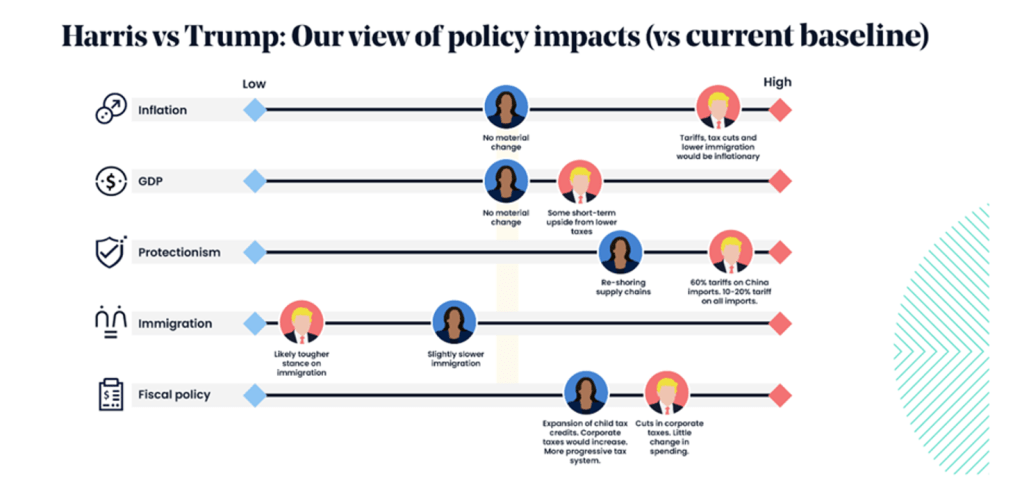
Historically, when the Fed cuts rates, emerging market (EM) stocks tend to do well, especially if there’s no recession. However, the U.S. elections could sway the outlook for EM assets. Any protectionist policies could hit them hard. So, given the current uncertainties, it might be wise to hold off on heavy EM investment until the economic picture becomes clearer.
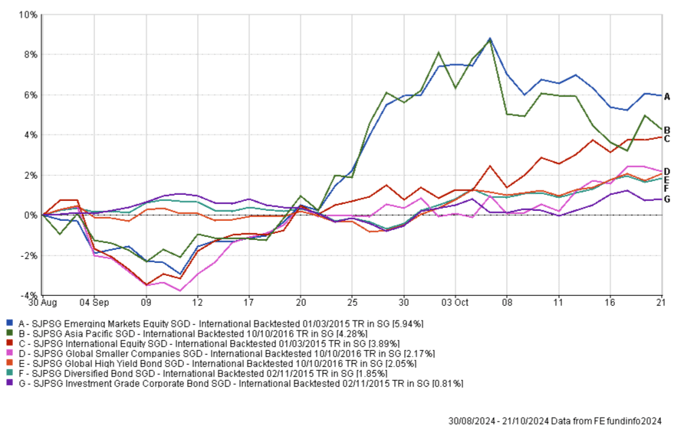
Data shows that after the first rate cut, EM stocks often outdo developed markets, especially if a recession is avoided. While initial performance might not show big differences, a clearer picture usually emerges about a quarter later as investors assess the economic landscape.
While EM stocks might not be a priority right now, EM bonds could offer good returns in this period, presenting potential investment opportunities amid U.S. growth concerns. Things might become clearer once election risks reduce and signs of economic stability appear.
The Fed & its Rate Cut
The Federal Reserve cut interest rates by half a percentage point, the first reduction since early in the Covid pandemic, to prevent a slowdown in the labor market. Rates now range from 4.75% to 5%, impacting short-term borrowing costs for banks and consumer products like mortgages and loans. The committee plans further cuts, aiming for another full percentage point by the end of 2025 and a half point in 2026, despite a dissenting vote from Governor Michelle Bowman.
The cut seeks to restore price stability without increasing unemployment, which remains low at 4.2%. Although job gains have slowed and the unemployment rate is expected to rise to 4.4%, inflation outlook has improved to 2.3%. The decision caused market volatility, with the Dow Jones fluctuating significantly.
Concerns persist about the labor market, as hiring rates have dropped, suggesting potential future rate cuts may vary among committee members. The Fed’s last rate reduction was in March 2020, followed by three increases due to inflation. While other central banks are cutting rates, the Fed continues to reduce its bond holdings, lowering its balance sheet to $7.2 trillion, down $1.7 trillion from its peak.
Investor Takeaway
Overall, the current environment looks good for stocks, though the U.S. presidential election could cause some market nerves. For gold, while the environment usually doesn’t favor price increases, it still holds an important place as a diversifier in uncertain times. As central banks tweak their strategies, investors should feel comfortable with the current rate cuts, while remembering that every cycle is unique, especially in our current politically charged world.
Let’s tackle a topic that’s increasingly relevant for many individuals living and working abroad: setting up a comprehensive investment portfolio as an expat in Singapore. Whether you’re fresh off the plane or have been in the Lion City for a while, understanding how to build an effective investment strategy is crucial for your financial well-being. Let’s explore the key aspects to consider when constructing your investment portfolio in Singapore.
Understanding Your Financial Goals
The first step in setting up your investment portfolio is to clearly define your financial goals. Are you looking to grow your wealth for retirement, save for your children’s education, or build a security cushion for unexpected expenses? Your goals will significantly influence your investment choices, so take the time to formulate a plan that aligns with your objectives. I’ve written a little bit about it here:
Once your financial goals are established, the next step is to assess your risk tolerance. This refers to how much risk you’re willing to accept in pursuit of those goals. In general, higher potential returns often come with higher risk. As an expat, consider factors such as your investment horizon, financial situation, and emotional comfort with market fluctuations. Establishing a clear understanding of your risk tolerance will guide your asset allocation strategy. It may be very tempting to go for something incredibly high risk when you see the high returns, but do beware. Think to yourself, “Would I be comfortable to lose all of this money if things were to go wrong?” If the answer is no…opt for a lower risk portfolio.
Understanding the Singapore Market
Singapore is one of the most dynamic financial centers in Asia. The country boasts a stable economy, a robust regulatory environment, and a diverse range of investment options. Familiarising yourself with local markets—such as the Singapore Exchange (SGX)—and understanding industries that drive growth, like finance, technology, and healthcare, is crucial when making informed investment decisions. Check out my latest article here:
When constructing your investment portfolio, diversification is paramount. A well-diversified portfolio can help manage risk and reduce the volatility of your overall returns. If you are a bit more cautious with your investments, try incorporating bonds or fixed income in your portfolio. If you’re unsure as to what some of these terms mean, you can check out this article here:
I always think it’s best to think about your goals and risk tolerance first, before investing. If you are unsure, it’s best to seek the advice of a professional – they can also give you a bit more information in terms of tax, and how to successfully structure your investments.
Moving to Singapore, or anywhere for that matter, is an exciting move! But, it does require a bit of getting used to. One of which is how to navigate your finances in a new country.
Singapore is one of the world’s leading financial hubs, known for its stable economy, business-friendly environment, and strategic location in Southeast Asia. As expats, it’s essential to familiarise ourselves with the following aspects of the economy:
1. Currency and Cost of Living:
Singapore’s official currency is the Singapore Dollar (SGD). The cost of living can be high, especially in terms of housing, dining, and transportation. As you plan your budget, remember to research typical prices for groceries, utilities, and other everyday expenses. Check out my recent article on Singapore’s cost of living here:
Singapore has a progressive income tax system, which means that the tax rate increases as your income rises. Fortunately, the tax rates are relatively low compared to many other countries, with no capital gains tax and no inheritance tax. Understanding your tax obligations, including filing dates and deductibles, is crucial to staying compliant and minimising liabilities. Find out more about tax here in Singapore with these articles:
Singapore boasts a sophisticated financial services sector. Expats have access to a wide range of banking and investment options. From local banks to international institutions, the choices are plentiful. Familiarise yourself with saving accounts, fixed deposits, and various investment vehicles like mutual funds, stocks, and bonds. It’s always advisable to consult a financial advisor, particularly one who understands the regulations that apply to expats. I wrote an article on this exact topics here:
The Central Provident Fund (CPF) is a government-mandated savings plan for Singaporeans and Permanent Residents, helping them save for retirement, healthcare, and housing. As an expat, you probably won’t be eligible for CPF contributions, but understanding this system can provide insight into Singapore’s approach to financial security. You can however (and do read that article above) opt into the SRS (Supplementary Retirement Scheme). This works similar to CPF but is also open to foreigners, and offers various tax benefits.
5. Insurance:
Health insurance is another critical aspect of financial literacy. Singapore has a high standard of healthcare, but medical care can be expensive without insurance. Depending on your employment package, you may have health insurance coverage included. Otherwise, be proactive in researching local insurance providers to ensure you have adequate health and life insurance. I always say that having medical insurance through work is good, but you should always have your own as a back-up. You can read more here:
– Open a Local Bank Account: This simplifies your financial transactions and may offer better exchange rates than foreign accounts.
– Create a Budget: Track your spending to get a clear picture of your financial situation in this new country.
– Educate Yourself: Attend workshops or read financial literacy materials available for expats in Singapore. The more informed you are, the better financial decisions you can make.
– Network: Join expat groups or forums. Fellow expatriates can share valuable knowledge and experiences regarding managing finances in Singapore.
Understanding Singapore’s economic landscape is vital for expats aiming to thrive financially. By familiarising yourself with the local currency, tax system, financial products, and insurance options, you’ll set yourself up for success. As always, seek professional advice when needed, and continue educating yourself on financial matters.
For many expats here in Singapore, we are earning in SGD, but we may have cash or assets in various other currencies. This can often pose certain additional risks when it comes to investing, mainly, currency risk. Currency risk, also known as exchange rate risk, is the risk that the value of your investment will fluctuate due to changes in the exchange rate between, for example, the euro (EUR) and the Singapore dollar (SGD). Here’s how this risk can affect your investment, and what you should take note of before you decide to invest in a certain currency: (FYI I’m going to be using euros as the main example currency here)
Fluctuating Exchange Rates: If you invest in assets denominated in euros, the value of those assets will be influenced by the exchange rate between the euro and your home currency (SGD). If the euro strengthens against the SGD, the value of your investment in SGD terms will increase. Conversely, if the euro weakens against the SGD, the value of your investment in SGD terms will decrease.
For example, if you invest €1,000 and the exchange rate is 1 EUR = 1.5 SGD at the time of purchase, your investment is worth 1,500 SGD. If the exchange rate later changes to 1 EUR = 1.3 SGD, your investment would then be worth only 1,300 SGD.
2. Impact on Returns: Currency fluctuations can significantly impact your returns. Even if your euro-denominated investments perform well in their local market, adverse currency movements can erase or diminish your gains when converted back to SGD.
3. Hedging Options: To manage currency risk, investors can use various hedging strategies. These may include forward contracts, options, or other financial instruments that can help offset potential losses due to currency movements. However, hedging comes with its own costs and considerations. I don’t often suggest this to my clients as hedging is a higher-risk strategy. However, for an avid & experienced investor, this is a good option.
4. Diversification: Diversifying your investments across various currencies can help mitigate currency risk. By holding a mix of assets denominated in different currencies, you may reduce the potential negative impact of fluctuations in any single currency. Diversification, as you will know if you’ve read a lot of my articles, is a key part of investing, and whilst it’s not smart to invest in every single currency, having a mix of currencies such as the one you earn in, the one where you have assets etc. is a good way for lessening exchange rate risk.
5. Long-Term vs. Short-Term: If you are investing for the long term, short-term currency fluctuations might be less of a concern since over time, currencies tend to fluctuate in cycles. However, if you’re looking at a shorter investment horizon, currency risk may significantly affect your returns.
6. Global Economic Factors: Currency values are influenced by a variety of factors, including interest rates, inflation, political stability, and overall economic performance in both regions. Staying informed about these factors can help you anticipate potential currency movements.
These are key points to remember if you are faced with currency risk; investing in euros while earning in SGD exposes you to exchange rate risk, which can affect the value of your investments when converted back to your home currency. It’s essential to consider this risk in your investment strategy and explore ways to manage or mitigate it based on your investment goals and risk tolerance.
Living as an expatriate can be both an exciting adventure and a financial challenge. Whether moving for work, study, or personal reasons, managing finances and remittances effectively is crucial for maintaining stability and ensuring that hard-earned money gets where it needs to go. Below are some best practices for expats to manage their finances and remittances efficiently.
Understanding Local Financial Systems
One of the first steps for expats is to familiarise themselves with the local financial systems of their host country. This includes understanding banking regulations, tax implications, and currency exchange rates. Choosing the right local bank is essential, as some banks may cater better to expats by offering services such as foreign currency accounts or international wire transfers. It’s crucial to research any associated fees and access to ATMs, as these can impact your daily banking experience and overall financial health.
I found that setting up a bank account with DBS was the easiest for foreigners. All I needed was a letter from my local employer and the set up was swift. DBS is also very good because they have multi-currency options, perfect for if you’re travelling a lot.
Creating a Budget
Budgeting is a fundamental skill for successful financial management. Expats should create a budget that includes their income, expenses, and remittance goals. This helps in tracking spending habits and allows for better planning of monthly expenses, such as housing, food, utilities, and transportation.
It’s beneficial to categorise expenses into needs and wants, ensuring that necessary expenditures are covered before allocating money for discretionary purchases. Regularly reviewing and adjusting the budget can help expats manage financial fluctuations, especially in a new and sometimes unpredictable economic landscape.
Technology plays a significant role in streamlining financial management. Expats can take advantage of various apps and online tools for budgeting, transferring money, and tracking expenses. Many digital platforms offer real-time currency conversion, allowing expats to make informed decisions when sending remittances home. Moreover, using online banking apps, budgeting tools, and expense trackers can simplify the process of managing finances, making it easier to stay organised and on top of payments.
Be careful with ensuring that you are doing secure payments and using legitimate platforms. You can read more about fitech and cyber security here:
Sending money back home is often a priority for expats, whether it’s for family support or investment purposes. Selecting the right remittance method is vital. Traditional banks may offer remittance services, such as DBS offering free remittance to most countries (UK included), but they often come with high fees and less favorable exchange rates.
In contrast, online money transfer services and mobile apps like Wise, Remitly, or PayPal can provide cheaper, faster options. Expats should compare the costs, speed, and convenience of different remittance services to ensure that they are getting the best deal for their needs.
I use OFX, as they are a lot cheaper than the banks, even cheaper than Wise & they also offer great customer service. With a 24 hour hotline, you’re not going to worry about where your money is. If you’d like to get in touch with them, let me know and I can put you in contact!
Understanding Tax Obligations
Tax obligations can be complex for expats, often varying significantly from country to country. Many nations tax worldwide income, which means that expats may have to file tax returns both in their host country and their home country. It’s essential to understand the tax treaties that may exist to avoid double taxation. Consulting with a tax professional who specialises in expat finances can greatly benefit individuals seeking to navigate these complexities. Staying informed about changes in tax laws and obligations is vital for avoiding penalties and ensuring compliance.
You can read some specific tax articles that I’ve written here:
Lastly, establishing an emergency fund is a critical financial practice for expats. This fund serves as a financial safety net in case of unforeseen circumstances, such as job loss, medical emergencies, or unexpected expenses. A good rule of thumb is to save at least three to six months’ worth of living expenses. This fund can provide peace of mind, allowing expats to focus on their new life abroad without the constant worry of financial insecurity. Regularly contributing to the emergency fund, even in small amounts, can accumulate over time and offer significant support in challenging times.
You can read more about emergency funds and what to do before you invest here.
In conclusion, managing finances and remittances as an expat involves a careful blend of understanding local systems, budgeting effectively, utilising technology, considering remittance options, staying informed about tax obligations, and building financial resilience through an emergency fund. By adopting these practices, expats can navigate their financial landscape more confidently, ensuring a successful and stress-free experience in their new country.
Today, we’re diving into the fascinating world of pensions — specifically looking at the systems in the UK, Australia, and Singapore. We’ll also touch on pensions in Hong Kong and France, giving you a clearer picture of how state and private pensions work, who is eligible, and what to do if you move abroad.
Let’s kick things off with the United Kingdom. The UK pension system is primarily made up of two components: the State Pension and private pensions. The State Pension is a flat-rate benefit paid to those who have made sufficient National Insurance contributions during their working life, currently set at 175.20 pounds a week for the full amount as of 2023. You can begin claiming your State Pension once you reach the State Pension Age, which is gradually increasing to 67. For those who have lived and worked in the UK, accessing your pension if you move abroad is still possible. You can claim it, and it might even be adjusted based on the country you move to.
In addition to the State Pension, many people save into private pensions. These might be workplace pensions or personal pensions. With workplace pensions, employers often match contributions, making this an excellent way to save for retirement. Remember, however, that you typically cannot access these funds until you’re 55, although this is set to rise to 57 in 2028. If you move abroad, checking the regulations in the host country is crucial because rules around pension access can vary significantly.
Now, let’s hop over to Australia, where the pension landscape is a bit different. The Age Pension is available to Australian citizens and residents aged 66 and a half, rising to 67 by 2023. The amount you receive is income and assets-tested, and the government aims to provide support for those who need it most.
Alongside the Age Pension, there’s the Superannuation system, a compulsory savings scheme where employers contribute a percentage of workers’ earnings into a super fund. At retirement, you can often access these funds, and there are several conditions under which you can access your Super if you move overseas – notably, if you have left Australia permanently, you might be able to access your super after a waiting period.
Next up is Singapore, where their pension system is known as the Central Provident Fund or CPF. This is a mandatory savings scheme designed to provide for retirement, healthcare, and housing. Most employees must contribute to their CPF, and the amounts vary based on age and salary. Do note that this is only mandatory for Singapore Citizens & PR, so for expats you can add into the SRS account instead:
Upon reaching the age of 55, you can withdraw a portion of your CPF savings, and at age 65, you’ll start receiving monthly payouts from your CPF Life scheme, ensuring a steady income stream in retirement. If you decide to move overseas, CPF savings can typically be withdrawn once you have officially left Singapore, which is a fantastic benefit for expatriates.
Do remember that, seen as most expats are not PR, it’s a good shout to contribute, either into SRS, or by creating your own retirement fund, otherwise you may be left with no pension!
While we’re focusing on these three countries, let’s briefly mention Hong Kong and France.
In Hong Kong, there’s the Mandatory Provident Fund (MPF), where both employers and employees contribute to a retirement savings scheme. Once you retire at 65, you can access your funds. For those moving abroad, you may be able to withdraw your MPF contributions as a non-resident.
In France, the system combines a state pension and complementary plans. Employees contribute throughout their working lives and can start taking pensions from the age of 62. When moving abroad, expats can still access their pensions, although it may involve some administrative steps.
So, there you have it! A quick overview of pensions in the UK, Australia, and Singapore, with a touch of Hong Kong and France. Remember, pension systems can often seem complex, especially with the added layer of international regulations, so always do your research or consult with a financial advisor, particularly if you plan on moving abroad.
I’m going to start this article with a controversial opinion; I don’t think Friends was actually that good. I much preferred the crossover storylines & humour of Seinfeld, and I didn’t think it was as ground-breaking as Sex And The City. However, I will say that Friends did explore very important topics, one of them being money.
This show really highlighted the relationship between friends, work, money and how each character dealt with these situations. So I thought, seen as I’ve done The Simpsons, Sex And The City, and Seinfeld, it would be cool to analyse each character and how they behave with money. Of course, we are going to explore topics about rent (like how the hell did Monica and Rachel have that huge apartment in NYC!), careers, and if I think each character was good at saving and investing.
Chandler Bing
Chandler is a great character to analyse financially. Although his career is a big vague (something in IT management?), we see his career grow significantly, to where he is considered a higher income earner. Some articles say his salary would have been roughly USD 100,000 per annum, with others saying up to USD 180,000. I can imagine that this corporate role of his gave great benefits; probably health insurance, bonuses and maybe even contributions into a 401K. This would mean that Chandler would have a good capacity to save- a high income with less fixed expenses. And we can see that throughout the show, mainly when he does a mid-career switch and becomes an intern. This would mean that he would have taken a massive pay cut, but that doesn’t seem to phase him. This tells me that he had enough saved up in his emergency fund to be able to still cope, even on a lower salary. The only red flag Chandler has when it comes to money is his willingness to loan a friend cash without expecting it to be repaid. He lends Joey a lot of money, and covers a lot of his expenses, and I don’t think Joey pays it all back. To me, this shows that Chandler has a blurred line between logic and emotion, particularly with money. He could have learnt to either say no to Joey, or set some expectations as to when and how he would like to be repaid.
Rachel Green
Rachel’s career development throughout the show is very interesting. She starts off as a runaway bride from a rich husband, and we know her family is well-off, but she gives all that up and becomes a barista and waitress at Central Perk. It’s difficult to estimate her salary at this point, because wait staff do not qualify for minimum wage in the US; their base salary is very low and the rest is tips. Whilst tipping culture in the US is huge, one could argue that Rachel may not have been getting a lot of tips. She isn’t great at her job and often messes up orders. Moreover, Central Perk is a cafe, not a fine-dining restaurant, so the tips in general wouldn’t been as high as other establishments.
By the end of the show, she works in fashion, pulling a salary of roughly USD 55,000. I’ll explain later that her fixed expenses in terms of rent would have been very low. However, something tells me that Rachel’s expenses would have increased with her income; she doesn’t duplicate an outfit, and we see her with some designer pieces too. Although her job at Ralph Lauren would have given decent benefits (similar to Chandler), I think her lifestyle expenses would be more.
I’m unsure whether Rachel would be investing, as well as saving. She is hard-working, but she can also be spontaneous, which leads me to believe there’s not a tonne of forward-planning going on. She comes from a well off background, so there is a chance that her parents may have taught her the importance of investing, or she may have been completely sheltered from it.
Ross Geller
Maybe another controversial take- I cannot stand Ross. He has that toxic ‘nice guy’ trope, he doesn’t treat Rachel well and my biggest gripe is his job as a Palaeontologist. As someone who has a BSc (Hons) in Palaeobiology & Evolution, and an MA in Palaeolithic Archaeology & Human Origins, I can tell you right now that Ross’ job doesn’t make any sense. His lectures often cover non-palaeontological topics such as geology and sedimentology, and he often talks about his research in anthropology. These are all different things, and a lecturer would not be trained in all of these areas, or be hired to give lectures on all of them! Another point that always confused me is that Ross is portrayed as a higher income earner, with his salary being estimated at USD 75,000 a year. I know it’s very different to the US than in the UK, but I know for a fact that in England no palaeontologist would earn that amount.
But it’s not all peachy for Ross- he has a LOT of expenses; he’s the only one out of the six that lives alone, which means that he’s covering the rent by himself. He also has two kids and is three times divorced, which means that he would have a lot of outgoings in terms of child support and alimony.
Monica Geller
Monica has very good financial standing in the show. A head chef would have been pulling a salary of approximately USD 80,000 a year. Chefs have to work long hours, which would mean less time to spend money on going out. Not only that, if you work in a restaurant, it’s very common for your food to be covered, meaning that Monica wouldn’t have a tonne of expenses going out each month. Now let’s talk about the apartment. That place was huge, and we all know that New York is super expensive, even back in the 90s. So how did Monica (and Rachel) keep up with rent every month? It’s mentioned in the show that the apartment originally belonged to her grandmother, and when she moved away, Monica began living there and started subletting it out (illegally). This apartment was rent-controlled, so the rent would have only been USD 200! This would have been so cheap when spilt between her and Rachel, meaning that Monica’s living cost would have been very low indeed.
Moreover, Monica has quite an organised, cautious and responsible personality. This tells me that she was provably a prudent saver and investor, and she probably would have been investing in cautious portfolios. This would mean that sh’e likely be seeing moderate returns of 4-5%, meaning that her money would have been out-performing inflation. Therefore, Monica would be well set up for future kids’ expenses, and retirement.
Phoebe Buffay
Arguably the lowest earner out of the bunch, Phoebe’s salary is very difficult to estimate. Like Joey at times, we see her doing lots of various odd jobs, such as free lance caterer, busker, or a masseuse. A masseuse in the 90s could have drawn a salary of roughly USD 50,000. So at times when Phoebe’s salary was consistent, she could have been managing ok. Moreover, she lives with her grandma, meaning low fixed expenses, and she even inherits this property when her grandma passes. Whilst this would mean additional costs, such as maintenance and various taxes, that would be a huge boost for Phoebe’s assets. Other than this, I get the feeling that Phoebe often lives paycheque to paycheque, and therefore not a lot of space for savings and investing.
Joey Tribbiani
Joey’s character I think is the most interesting to explore. Throughout the show, we see Joey’s professional career as an actor- a job which is not always consistent or full time. And because of this, we often see Joey going through bouts of unemployment, or doing odd-jobs. However, by the end of the show, he is arguable earning the most out of the six, with his annual salary estimated at around USD 130,000. One thing I like about Joey is that, although his salary massively increases, his lifestyle doesn’t seem to change a tonne; he stays living in that apartment for the most part, he still enjoys home cooked Italian food or take-out, and we don’t see him spending too much on frivolous luxury items.
Another positive portrayal in the show is the bond between him and his family. They seem incredibly supportive of him, and value quality time together. Coming from a Mediterranean family myself, I can imagine that Joey’s culture and family dynamics contributed a lot to his money habits. From personal experience, immigrant families tend to have very strong work ethics, understand the importance of saving and realise that there are non-material ways that you can feel rich. I’m sure a lot of these mindsets rubbed off on Joey, but one thing about him that isn’t so good is the fact that whilst he is out of work or doing odd-jobs, he often relies on Chandler for financial support. Chandler not only covers his rent and food on several occasions, but he also pays out of pocket for Joey’s hernia surgery, which if you know anything about the US healthcare system, you know that it’s really quite costly! A fan estimated the amount that Joey owes Chandler, at a whopping USD 101,760!
All in all, Friends is a great portrayal of a group from various income brackets, with characters with many different money mindsets. We can learn a lot from them, such as the importance of setting aside for a rainy day, minimising our fixed expenses, and how to deal with friends in different money situations to us. I’ve really enjoyed doing this financial deepdive into the show, but I’d like to move away from US (particularly NYC) based shows! So please give me some suggestions for the next ones!