Do I Need a Financial Adviser as an Expat?

If you’re living and working abroad, chances are you’ve already made a number of financial decisions that most people back home never have to think about—things like multi-currency income, international tax rules, private healthcare, and schooling costs. You might be earning well, enjoying life, and managing just fine on your own.

But at some point, the question arises: “Do I really need a financial adviser?”

Here’s a detailed, honest guide to help you decide—especially as an expat in Singapore.

Why Expats Face Unique Financial Challenges

Expats often juggle more complexity than they realise:

  • Earnings in one currency, savings in another
  • Multiple tax jurisdictions
  • Pensions and savings scattered globally
  • International school fees
  • Changing immigration or residency statuses
  • No access to home-country financial products
  • No CPF if you’re not a Singapore citizen or PR

All of this means your financial decisions aren’t just about “what fund to invest in”—they’re about strategy, timing, structure, and risk management across borders.

When You Might Not Need an Adviser

Let’s start with the honest bit.

You might not need a financial adviser if:

  • You have a strong financial background (e.g. you’re a CFA or accountant)
  • You’re comfortable researching investments and tax implications yourself
  • Your finances are still fairly simple (e.g. you’re single, renting, no dependents)
  • You’ve already created a well-diversified, low-cost investment strategy
  • You have time and interest in actively managing your own finances

That said—even financially savvy people often underestimate the value of a second pair of eyes when cross-border issues are involved.

When an Adviser Becomes Valuable

Here’s where an adviser can make a real difference:

1. You’ve hit a life transition

Marriage, divorce, children, relocation, career break, inheritance—these moments carry major financial implications. An adviser can help you map a plan that reflects your new reality.

2. You have no access to employer pension schemes

Without an automatic pension structure, expats must build retirement savings intentionally. Advisers can help design investment portfolios and income plans for later life.

3. You earn well but aren’t sure where the money goes

This is incredibly common. A good adviser can show you how to redirect surplus income into wealth-building strategies, without compromising your lifestyle.

4. You want to send children to international school or university

The costs are high, the timelines are long, and the inflation is real. You’ll need a structured investment plan—not just cash in the bank.

5. You plan to repatriate

Whether you’ll return to the UK, Australia, or elsewhere, an adviser can help bridge your Singapore-based life with your long-term home-country goals—without triggering tax or currency surprises.

6. You don’t want to DIY everything anymore

Some expats hit a point where managing every spreadsheet and market update becomes exhausting. Delegating can be both smart and liberating.

What Should an Expat Adviser Help With?

A quality financial adviser should do more than talk about products.

Here’s what they should offer:

  • Cash flow planning across currencies
  • Investment advice tailored to your time horizon, risk tolerance, and location
  • Education planning for international school and university
  • Retirement projections that account for different jurisdictions
  • Tax awareness (not advice—but they should work with your accountant or tax advisor)
  • Insurance reviews (life, health, critical illness, income protection)
  • Estate planning for global assets
  • Regular progress reviews and portfolio rebalancing

They should also help you avoid financial pitfalls unique to expat life—like becoming unintentionally tax resident in multiple countries, or holding accounts that could be frozen after a move.

What a Financial Adviser Should Not Do

Red flags to watch out for:

  • Selling high-commission products with hidden lock-ins
  • Offering “one-size-fits-all” portfolios
  • Recommending structures you don’t understand
  • Dodging questions about fees and total cost
  • Pushing “savings” or “bonuses” that sound too good to be true
  • Talking in jargon instead of plain English

A good adviser should be transparent, licensed, and focused on your goals—not theirs.

What About Fees?

Financial advisers are paid in one of three ways:

  1. Fee-only: You pay an agreed fee for advice or a plan—no product sales involved.
  2. Commission-based: The adviser earns money through product recommendations (e.g. insurance, investment platforms).
  3. Hybrid: A mix of planning fees and product-based revenue.

In Singapore’s expat market, most advisers are hybrid. That’s not necessarily bad—as long as:

  • The fees are clearly disclosed
  • The advice is tailored to your needs
  • You understand exactly what you’re signing up for

If you’re unsure, ask for a full breakdown and always get it in writing.

Should You See an Adviser Even If You’re Not Ready to Invest?

Yes—especially if you:

  • Have a long-term goal (e.g. career break, home purchase, retirement abroad)
  • Are unsure how to structure your savings
  • Want clarity on what’s possible with your income
  • Feel overwhelmed by the number of decisions to make

The best advisers work with clients in planning mode, not just those ready to hand over money to invest.

You don’t need to be rich to benefit from financial advice—you just need to have goals, complexity, and curiosity.

As an expat, your financial life spans borders, currencies, and systems. A good adviser won’t just help you grow wealth—they’ll help you stay on track, reduce risk, and make smarter decisions at every stage of your journey.

Wondering whether advice is right for you? Let’s have a low-pressure chat and see what you might be missing. Sometimes the smallest tweaks make the biggest difference.


Navigating the Changes: Key Highlights from the UK Autumn Budget 2024

With the recent unveiling of the UK Autumn Budget 2024, significant changes to personal and corporate tax regulations are set to reshape financial landscapes for individuals and businesses alike.

In his latest write-up, Peter Webb, our expert technical consultant delves into the nuanced details of these tax adjustments, providing clarity on what to expect moving forward. From adjustments to income tax thresholds to corporate tax rate modifications, understanding these changes is crucial to effective financial planning.

Join us as we explore the implications of this budget on your financial strategy and what it means for the future of taxation in the UK.

Personal

  • Rates of income tax and National Insurance (NI) paid by employees, and of VAT,
    to remain unchanged
  • Income tax band thresholds remain frozen until 2028
  • Basic rate capital gains tax on profits from selling shares to increase from from
    10% to 18%, with the higher rate rising from 20% to 24%
  • Rates on profits from selling additional property unchanged
  • Business Asset Disposal Relief tax rate to rise to 18% over the next 2 tax years
  • Business Relief and Agricultural Property Relief will be limited to £1mn from April
    2026 with 50% IHT relief above that limit
  • IHT relief on AIM shares to be limited to 50% (ie e􀆯ective 20% IHT rate)
  • Stamp duty surcharge, paid on second home purchases in England and Northern
    Ireland, to go up from 3% to 5%
  • Point at which house buyers start paying stamp duty on a main home to drop
    from £250,000 to £125,000 in April, reversing a previous tax cut
  • Threshold at which first-time buyers pay the tax will also drop back, from
    £425,000 to £300,000
  • 5p cut in fuel duty on petrol and diesel brought in by the Conservatives, due to
    end in April 2025, kept for another year
  • Basic and new state pension payments to go up by 4.1% next year due to the
    “triple lock”, more than working age benefits
  • Inheritance tax threshold freeze extended by further two years to 2030, with
    unspent pension pots also subject to IHT from 2027


Business

  • Companies to pay NI at 15% on salaries above £5,000 from April, up from 13.8%
    on salaries above £9,100, raising an additional £25bn a year
  • Employment allowance – which allows smaller companies to reduce their NIC
    liability – to increase from £5,000 to £10,500
  • Tax paid by private equity managers on Carried Interest to rise from up to 28% to
    up to 32% from April
  • Main rate of corporation tax, paid by businesses on taxable profits over
    £250,000, to stay at 25% until next election”

We encourage our readers to engage with us on this topic. If you have questions about how these budget changes may affect your personal or corporate tax planning, or if you need expert advice tailored to your specific circumstances, please don’t hesitate to reach out. You can connect with Peter & I through the comments section below or contact us directly at peter.webb@sjpp.asia. Your financial well-being is our priority, and we’re here to help you navigate these changes effectively!

Updates On The UK Spring Budget 2024

For Brits, the most recent Spring Budget announcement was incredibly important, as it gave us some very key and drastic updates for tax and spending. Essentially, Chancellor Jeremy Hunt aimed to deliver lower taxes, encourage investment and improve public services. Although the elections may affect this announcement, it’s still very important for Brits, particularly those abroad, to be aware of. Martin at Spice Taxation (Company Registration No. 202133724G), has written a very in depth piece on the Spring Budget. It’s incredibly useful to hear the views of a professional tax expert, and Martin has been kind enough for me to share his thoughts here. Of course, I myself am not a UK Tax expert, so I often seek the help of professionals, such as Martin, to help me and my clients with their tax planning when necessary.

Below is Spice Taxation’s write up on the matter.

Our Thoughts on the Spring Budget – 6th March 2024
The Most Important Budget for Expatriates since 2010


“Over the years I have discovered that I am just not very good at predicting Budgets. Speculation is always rife about what a Chancellor might do in face of this and that economic and political situation, but mostly the actual announcements just tend to underwhelm and disappoint. Maybe I just crave excitement!


However, all that changed with Jeremy Hunt’s Budget on 6th March. It is likely to be the last Conservative Party Budget before the next General Election – an election which the Labour Party is widely expected to win. So, it remains to be seen how many of the announcements will find their way onto the Statute books if Labour does win. That aside, it really was an exciting Budget which promises a lot of change, much of it positive.


For much of the speech, it felt like a ‘normal budget’ with a plethora of announcements about regional incentives, funding initiatives, levelling up grants, subsidies and tax breaks for the arts etc. However, there was also a number of genuinely eye-catching and important announcements which are also relevant to expatriates.


First of all, Jeremy Hunt announced a further reduction in National Insurance paid by employees and the self-employed of 2%, from 6th April 2024. For employees, this will reduce from 10% to 8% and for the Self-Employed from 8% to 6%. For those returning to the UK, this will be welcome news.


Secondly, he announced the intention to introduce a new Individual Savings Account – the UK ISA, with an annual subscription allowance of GBP 5,000, in addition to the existing threshold of GBP 20,000. This new ISA would hold British-only assets – equities listed on the four recognised UK stock exchanges, UK corporate bonds and gilts and collectives. This will be good for UK resident savers.


Third, there were a few property tax announcements which came as a surprise:


o The marginal rate of Capital Gains Tax on the sale of residential property will reduce from 28% to 24% from 6th April 2024. This is intended to help stimulate the property market. The basic rate will remain at 18%. This is good for anyone selling, gifting or assigning an interest in UK residential property from that date.


o Multiple Dwellings Relief for Stamp Duty Land Tax is being abolished from 1st June 2024 – this was a relief that allowed you to take the average purchase price for SDLT purposes where at least two properties were being purchased in a single transaction.

o Furnished Holiday Letting status is to be abolished from 6th April 2025, with some anti-forestalling provisions which came into effect on 6th March 2024.


o The geographical scope of Agricultural Property Relief and Woodlands Relief (two Inheritance Tax incentives) will be limited to assets situated in the UK only from 6th April 2024 – those situated in the Crown Dependencies and the EEA will lose their IHT protected status.


Fourth, the VAT registration threshold will rise to GBP 90,000 from 6th April 2024, an increase of GBP 5,000, which will be welcome news for small businesses.


However, perhaps the biggest and most barnstorming announcement was the abolition of ‘non-dom’ status from 6th April 2025. The Conservative Party has been a staunch defender of the ‘non-domiciled regime’ over many years, so it was something of a surprise to see them adopt an avowed Labour Party policy. Stealing their thunder no doubt. It is a very major announcement that will impact many people.

In a nutshell, the Government plans to delink a person’s ‘domicile status’ from their UK tax outcomes, and move to a residence-based set of incentives. Consultation documents are yet to be published, but the main features of the new system will be to:

– Abolish the ‘remittance basis of taxation’ for UK resident ‘non-doms’.

– Replace it with an opt-in system that will allow, seemingly anyone – including, presumably, British nationals – to exempt their non-UK incomes and gains from UK tax for the first four years of UK residence, provided that they have been continuously non-resident for at least the 10 previous years.

– Exempt from tax the remittance of these non-UK income and gains to the UK, which will be hugely simplifying in the long run.

– Retain Overseas Workday Relief for qualifying individuals for the first 3 tax years of residence.

– Apply world-wide taxation for all individuals from the 5th year of residence in the UK.

– Introduce a thoughtful set of transitional reliefs for certain ‘non-doms’ who are already resident in the UK

– Switch away from a ‘domicile based’ system of Inheritance Tax to a residence-based system, whereby qualifying individuals switch to IHT on world-wide assets only after 10 years of residence.

Keep anyone who leaves the UK within IHT for 10 further years, which presumably also will apply to British Expatriates too. UK assets remain within Inheritance Tax at all times, regardless of residence.

We are missing a lot of technical detail here which should be answered by the Consultation Documents that the Government will be publishing shortly. So watch this space! However, whilst I have many more questions than answers at the moment, at first sight the main impacts appear to be the following:


a) Tax planning for relocation to the UK is likely to change quite a bit and these proposals could amount to a generous tax break for returning British expatriates.


b) They will also make Inheritance Tax planning potentially a lot simpler and not so reliant on subjective judgments about where a person is domiciled.


c) It might possibly result in an exemption from Inheritance Tax for a swathe of non-resident British expatriates who have already been non-resident for at least 10 years, which would be quite a result!


I am going out on a limb a little by saying that it appears the proposals will also apply to those we currently regard as ‘domiciled’ in the UK. However, surely that is the point – it is switch away from a tax system where a person’s domicile was the deciding factor, to a tax system where the deciding factor is driven by residence. This potentially bodes extremely well for British expatriates.
If this Budget does turn out to be the Conservative Party’s fiscal swansong, it is perhaps fitting that its period of Government will be bookended by a commitment to enshrine in law a statutory test for residence in 2010 at the start, and a set of announcements that displace domicile with a new regime based on that very residence test at the end. Mastering the Statutory Residence Test is clearly going to be more and more important.
Beyond this, all tax rates, thresholds and allowances for Personal Tax remain frozen, as do the rates for Corporation Tax. The dividend allowance will fall to GBP 500 from 6th April 2024 and the Capital Gains Tax Annual Exemption will fall to GBP 3,000 from the same date. Class 2 and Class 3 voluntary National Insurance Contribution rates will remain unchanged at GBP 3.45 per week and GBP 17.45 per week respectively, and the New State Pension will rise to GBP 221.20 per week (of GBP 11,502.40 per year) from 6th April 2024.”


If you would like to discuss your own circumstances in confidence or would like to be on the subscriber list for Spice Taxation’s new dedicated coverage of these breaking developments, please contact Martin at martin@spicetaxation.com or by sending a Whatsapp to +65 96650019.

I’d like to thank Martin at Spice Taxation for allowing me to share this information with my readers. I am sure that this will help many of you plan your finances in relation to UK tax.

Tax Relief For Foreigners

It’s tax filing season, and a lot of expats here in Singapore don’t know that they’re eligible to certain tax reliefs. Today I’ll be talking about how you can legally save on your taxes in Singapore. Just a disclaimer, My job isn’t tax planning, I’m a financial consultant, but these are some things that I do and have researched, that you can put into practice. And of course, this is just for Singapore. I know about some tax laws in other countries but I’ll just be talking about Singapore today.

I want to do a quick overview of the tax system in Singapore, tax reliefs available here and a bit of an example of SRS savings. So you may be shocked as to how many expats are in Singapore. It’s actually approximately 1.68 Million. So quite a lot, but 1 in 8 lost their job in 2020. While job security is a worry to most of us, at least Singapore is doing quite well when it comes to dealing with Covid. And unemployment rate is definitely not as high as other countries during this crisis. There are also many affluent citizens and residents here. Tax, whilst low in Singapore, can still take away a large chunk of your salary.

For tax in Singapore, the amount you pay is broken down into various brackets. Singapore is seen as one of the top first world countries for having low tax, it’s somewhat of a tax haven, but you can see that if you are in the higher income bracket, for example $200k and above, your tax for the year is quite substantial.

So, how can we legally minimise the amount of tax we are paying each year?

There are several things that can give you tax relief. This may appeal more to those that plan on staying here long term, or even longer than just a couple of years, as all these reliefs add up in the long run.

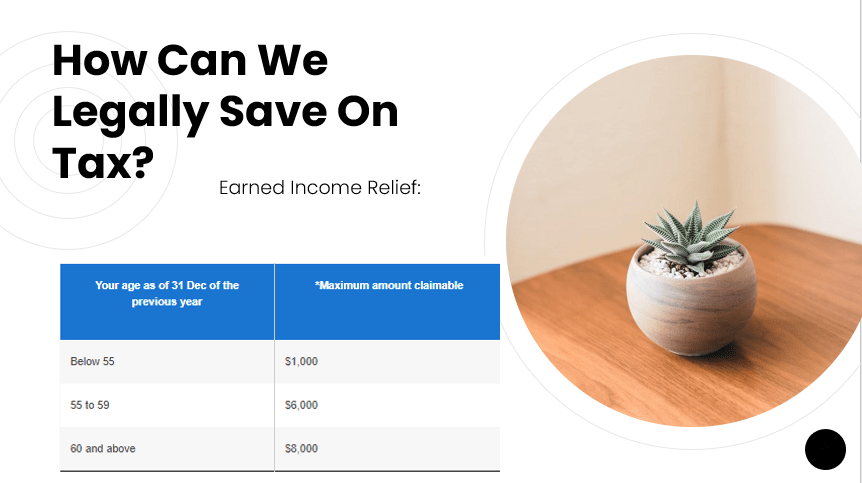
The first and easiest tax relief you can get is employment relief. This is automatically calculated into your tax and is capped at $1,000 for below 55. And then it goes up depending on age bracket.

Next is life insurance relief. If you have any insurance policies from an insurance company in Singapore, you are entitled to a relief of maximum $5,000 per tax year, provided the insurance is for yourself, and is not an accident or hospital policy, or a pure investment policy. This relief can be filed at the end of the tax year under e-filing.

If you have anyone here with you on a dependent pass and they’re not working, you can claim for tax relief. You are entitled to claim $2,000 for spouse, $4,000 for child and $9,000 for a parent on a DP.

To me, this is the most effective way to save on taxes. SRS scheme is great because not only does it offer you tax relief, but you can also make use of the money inside and grow that money for a retirement plan. And, what’s great is it’s available to expats, it’s actually more flexible for expats. Singaporeans can put $15,300 into SRS each year and expats can put $35,700. Just note that if you want to put this maximum amount in, you have to go to the bank and declare that you’re a foreigner.

Everything inside this account is eligible for tax relief, which is done automatically. After the retirement age, you can make withdrawals from this account penalty free. Before that, there’s a 5% charge. The great thing about SRS is after the retirement age, anything that you withdraw from the account, only 50% of it is taxable.

So what can we do with the money inside the account? Well, seen as the interest rate in an SRS account is about 0.05%, I would recommend putting it somewhere where it can grow more, so, if you leave Singapore or you decide to retire here, you’ve got a huge lump sum waiting for you. As you can imagine, if you are putting the maximum amount each year into SRS, you can have a very good pot of cash at the end.

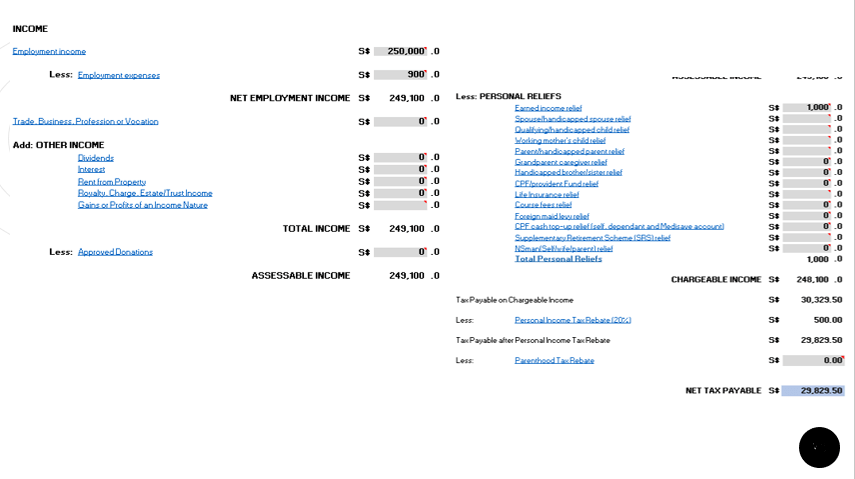
How does all of this look in terms of tax savings each year? Let’s take for example, a man on an EP who earns $250,000 a year. Say he claims $900 in tax on expenses. His original amount he should be paying on tax is $29,829.50

But let’s say he utilises all these tax reliefs he is eligible to, he will save about $10,547 per year on tax.

So you can see, this is a very substantial amount. SRS will give him a tax relief alone of $6.8k.

Here’s an example for someone on $100,000 a year. With all these tax reliefs, there a 4 and a half thousand dollar saving. Just on SRS alone that’s $3271 of savings.

Filing your taxes is so easy to do on the IRAS website, and with SRS being automatically calculated into your tax relief, all you really have to do is input your various other relief schemes. I think SRS in particular, is an excellent way for expats to plan for long term goals, such as retirement, whilst minimizing tax.